




 English
 Español
 русский



An installer cuts the tape on a carton, lifts out the connector and looks for the certification mark. What he finds is a part number on a blank label and a supplier who once wrote "CSA approved" in an email. For the last flexible link between a gas valve and a range, that gap matters: the mark is the only on-product evidence that the finished assembly, not just the tube inside it, was tested as a unit and built under a monitored quality system.
So the short answer first: treat "CSA certified stainless steel gas connector" as a claim to verify, not a description to trust. Verification comes down to four checks. A legible marking on the nut or collar. A listing that matches the certification body's public directory. The correct DN and length for the appliance load. And a thread form that actually fits the gas valve in front of you. Everything below supports those four checks.
What CSA Certification Actually Confirms
CSA Group is an accredited certification body as well as a standards developer. For gas connectors sold in the United States and Canada, the relevant documents are ANSI Z21.24 / CSA 6.10 for indoor appliance connectors and ANSI Z21.75 / CSA 6.27 for outdoor appliances and manufactured homes. When an assembly carries the CSA mark against one of those standards, three things have happened: samples passed the full clause set, the factory passed an initial inspection, and the plant now sits under ongoing follow-up inspections with periodic re-testing.
The clause set is not cosmetic. Assemblies are typically evaluated for leakage, pull and tensile strength, torsion, repeated bending, salt-spray corrosion, flame or elevated temperature exposure and flow capacity. Notice what those clauses have in common: they test joints and the finished assembly, not the tube alone. A producer that buys certified hose and crimps it in an uncertified workshop has no certification at all, even though the tube itself is perfectly good.
The distinction that trips up purchasing teams is "built to CSA 6.10" versus "certified to CSA 6.10". The first is a design claim. The second arrives with a file number, a listing and a factory under surveillance. If you want a plain-language refresher on the component before layering certification on top, this outline of what a stainless steel flexible gas connector is covers the basics.
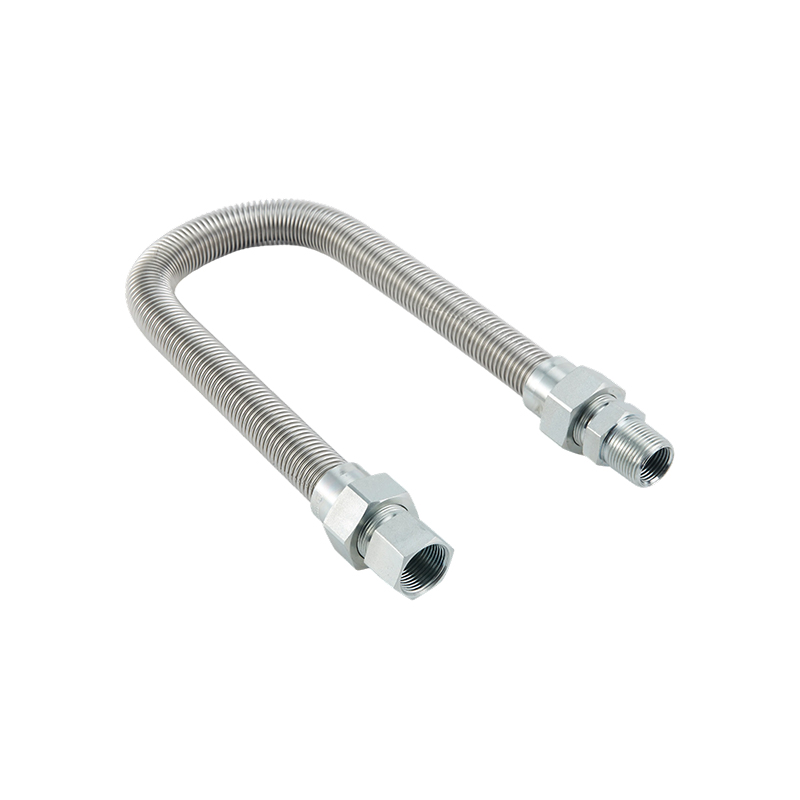
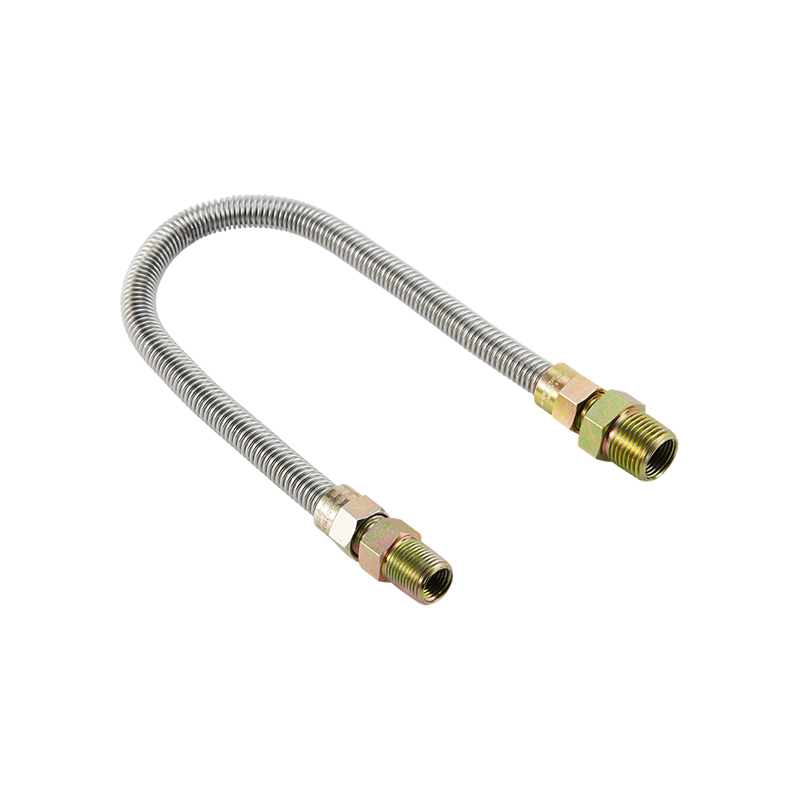 CSA-Certified Stainless Steel Gas ConnectorsReview CSA-certified stainless steel gas connectors across DN10–DN25 and common lengths, with details useful for confirming certification before ordering.View Product →
Read the Marking, Not the Brochure
Certification lives on the product in the form of a marking string, and that string should be complete enough for an inspector to trace back to a file. If a connector arrives with only "CSA" on a sticker and nothing else, ask for the certificate and the listing number before the pallet reaches the line.
| Standard | Market | Scope | What to confirm |
|---|---|---|---|
| ANSI Z21.24 / CSA 6.10 | US and Canada | Connectors for gas appliances, indoor use | Marked maximum length, pressure and temperature limits |
| ANSI Z21.75 / CSA 6.27 | US and Canada | Outdoor appliances and manufactured homes | Outdoor suitability stated in the listing |
| EN 14800 | European Union | Corrugated safety metal hose assemblies for domestic gas appliances | Notified body number and declaration of performance |
| BS 669-1 | United Kingdom | Domestic gas hose assemblies and end fittings | Gas family marked on the assembly |
A complete marking on a gas connector normally carries:
- Manufacturer or private-label name, plus the certification file number
- The standard the assembly is certified to, with the edition where required
- Nominal size in DN or inches, and the marked maximum length
- Maximum working pressure and temperature limit
- Lot or date code for batch traceability, plus a "do not reuse" note where applicable
Length deserves its own line item. Under ANSI Z21.24 / CSA 6.10, appliance connectors are commonly capped at about 6 ft (1.8 m); anything longer should be rigid pipe or a properly supported alternative. If a supplier quotes a 10 ft "certified" connector, read the certificate scope twice.
Inside a Certified Assembly: Four Interfaces That Decide the Outcome
Certification tests the assembly, but the assembly is only as durable as its weakest interface. The cutaway below marks where those interfaces sit.
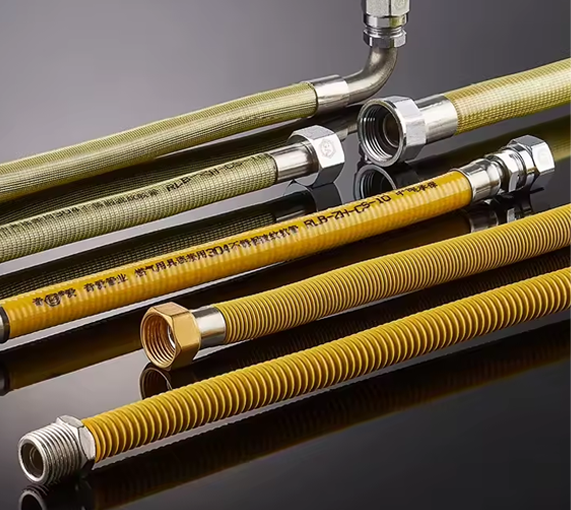
- Corrugated tube. Usually 304 or 316L stainless with a thin wall that is annealed so it stays flexible; the corrugation pitch drives both bend radius and noise behaviour.
- Braid sleeve. Stainless wire braid carries tensile load, stops the tube from elongating under pressure and absorbs abrasion on rough routes.
- Nuts. Brass or 304 stainless, hex profile, NPT or BSP thread. The thread form is a specification, not a preference; mixing the two families creates leaks that no certificate can prevent.
- Crimped ferrule. The ring that locks tube to nut. Crimp diameter is a controlled process parameter, and a poor crimp is the single most common origin of field failures.
Sizing: DN, Length and Appliance Load
DN numbers describe the nominal bore of the tube, not the thread on the nut, and the two get confused on purchase orders more often than they should.
- DN10, roughly 3/8 in: space heaters, compact cookers, short appliance runs
- DN12, light 1/2 in class: ranges and space heaters with tighter routing
- DN15, the 1/2 in workhorse: ranges, dryers, water heaters
- DN20, 3/4 in: higher-input commercial ranges and boilers
- DN25, 1 in: large-input appliances and manifold connections
Length is usually a bigger risk than bore. An oversized connector forces a loop, the loop kinks at the minimum bend radius, and the braid takes the load instead of the tube. Buy the marked length you need, route it in a single gentle arc, and keep the connector downstream of the appliance shut-off valve where it belongs.
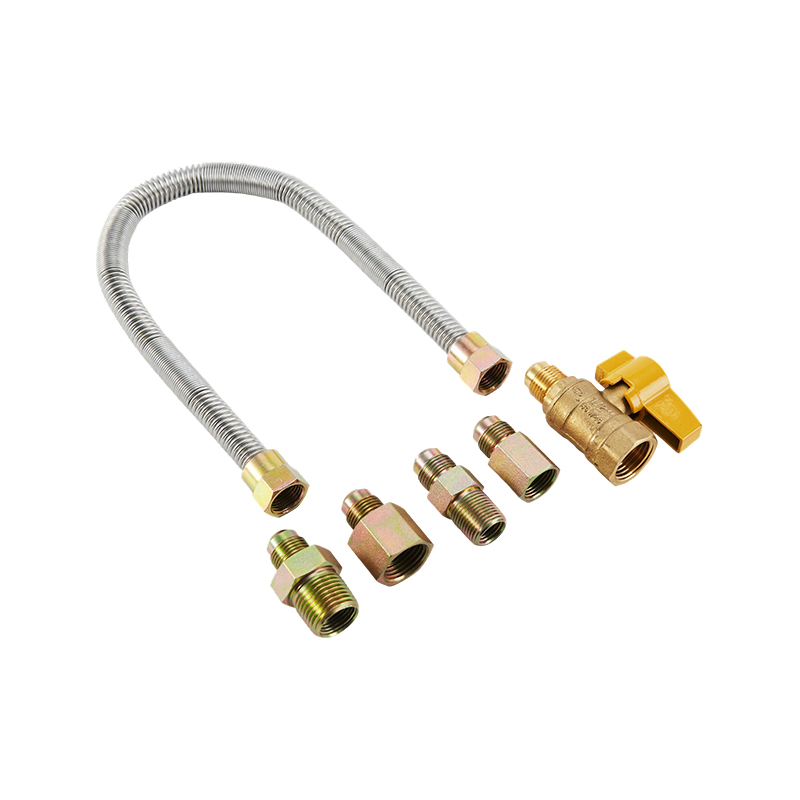
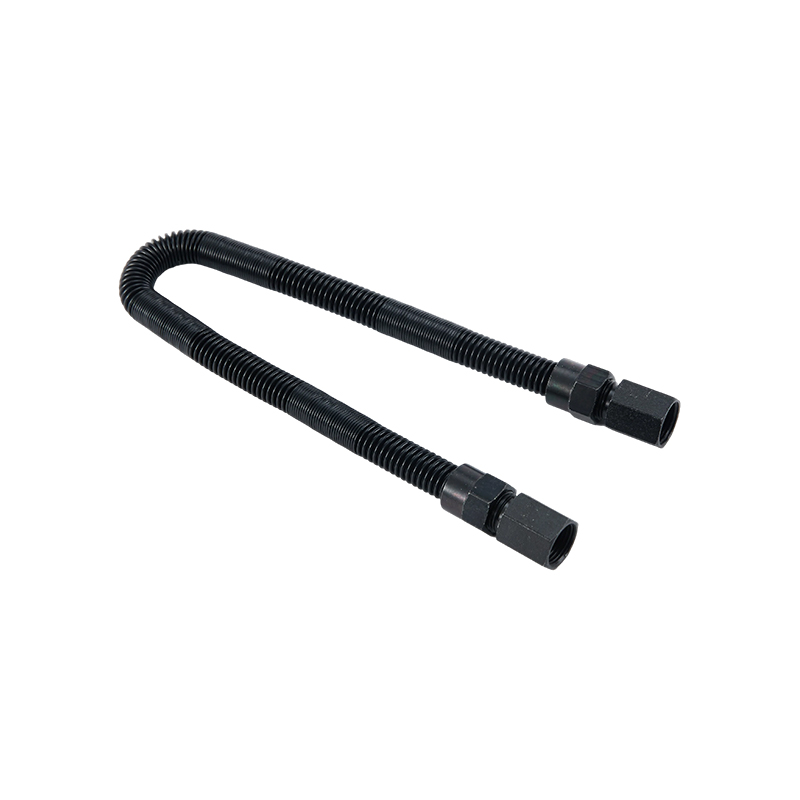 DN15 Stainless Steel Gas Connector with Flare NutThis DN15 304 stainless steel connector offers a 15/16-inch flare nut and multiple adapters for gas pipeline and equipment connections; choose marked length carefully.View Product →
When the Connector Whistles
A whistle or hum after commissioning is rarely a leak. It is usually resonance: gas accelerating through a corrugated bore while the corrugation pitch and the appliance orifice set up a tone. Wrapping the tube in tape does not solve it, and neither does swapping to a longer hose. The real fixes are a smoother internal bore, a different corrugation pitch, or a check of the appliance regulator and orifice sizing.
For retrofit work in apartments, a whistle-free design removes a repeat call-back that installers otherwise absorb themselves. Confirm with the supplier that the noise-suppressing construction is covered by the same certification as the standard version, not treated as an accessory.
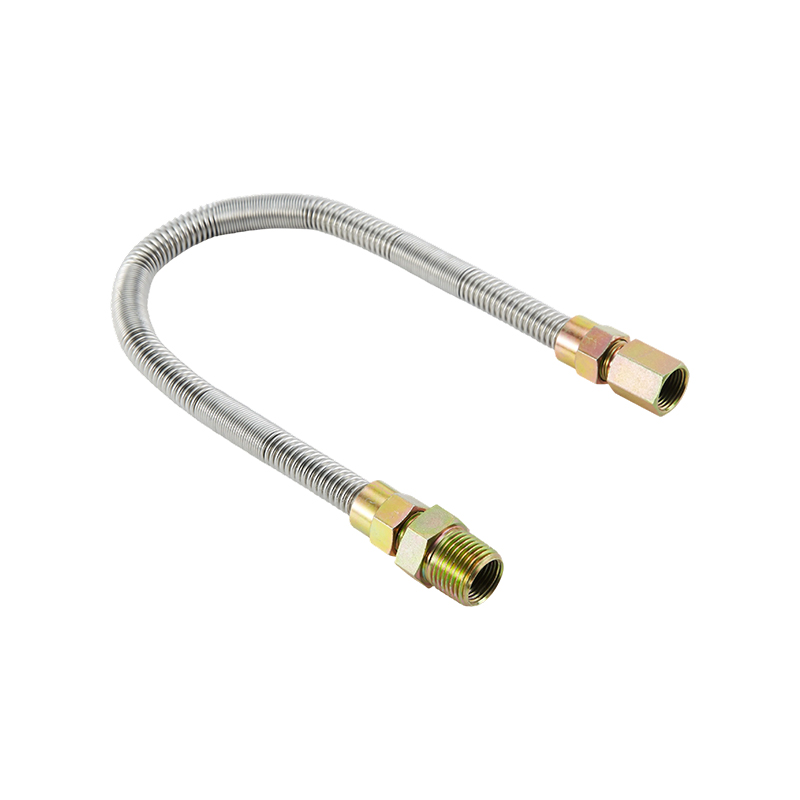
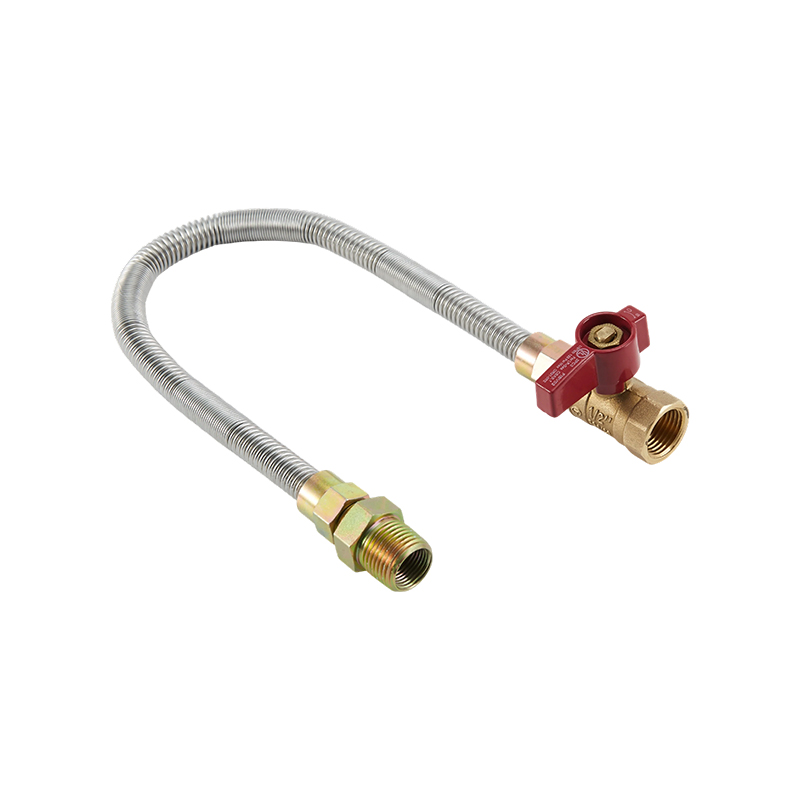 DN20 Whistle-Free Stainless Steel Gas ConnectorA DN20 304 stainless steel connector with whistle-free construction and 1 1/8-inch flare nut, aimed at quieter gas connections in retrofit work.View Product →
Stainless Steel or Rubber: Where the Difference Shows
Rubber retains one genuine advantage: it damps vibration and it is quiet. Stainless wins on everything that shortens service life in a kitchen, a laundry room or a rooftop cabinet.
The chart is a qualitative profile built from material properties rather than a single test report, and it explains why utilities and inspectors favour corrugated stainless for concealed and outdoor routes. The trade-off you accept is conductance and stiffness: stainless transmits heat toward the valve and resists the tight 90-degree turn a rubber hose tolerates. Route it with a gentle arc and a support clip, and the stiffness stops being a problem.
Acceptance Checks Before You Sign for a Shipment
- Match the marking string against the certificate, the purchase order and the certification body's directory listing.
- Measure overall length on a sample against the marked length, not against the carton label.
- Gauge the thread by hand on one unit per lot: NPT and BSP do not interchange, and force is never the answer.
- Flex each sample once through a gentle arc and feel for braid damage, loose ferrules or a rustle that suggests a broken wire.
- Confirm the coating, liner and end fittings match the certified construction you approved, not a "similar" substitute.
- Record the lot or date code. Traceability is the practical value of certification when something goes wrong six months later.
Installation Details That Undo a Good Certificate
Most field failures are installation failures wearing a product's name. Over-tightening a brass nut splits the ferrule seat. Reusing a connector after a move ignores that the braid has already been work-hardened. Sealing compound on the first two threads migrates into the bore. A drip leg missing at the appliance inlet lets debris reach the orifice. These are documented in the step-by-step installation guidance most contractors already carry in their van, and they are worth re-reading before a busy season starts.
For buyers, the lesson is commercial rather than technical: the certificate protects you only when the connector is also stored flat, shipped without sharp bends and installed by someone who reads the marking. Suppliers who put the marking string on the carton, not just the nut, make that easier for everyone downstream.
Frequently Asked Questions
What does CSA certified mean on a gas connector?
It means the finished assembly was tested by CSA Group to a recognized standard such as ANSI Z21.24 / CSA 6.10 and produced in a factory that receives ongoing follow-up inspections.
Are stainless steel gas connectors safer than rubber hoses?
For heat, UV, ozone and rodent exposure, yes. Stainless retains strength where rubber hardens and cracks, though both depend on correct sizing and installation.
What size gas connector do I need for a range or dryer?
Most household ranges and dryers use a DN15 (1/2 in) connector. Check the appliance inlet and the run length, and never exceed the marked maximum length.
How long does a stainless steel flexible gas connector last?
Manufacturers typically rate them for many years of service, but the connector should not be reused after removal. Any sign of braid damage or corrosion means replacement.
Can a CSA certified gas connector be used outdoors?
Only if the listing states outdoor suitability. Outdoor appliances and manufactured homes fall under ANSI Z21.75 / CSA 6.27, a different scope from indoor connectors.
Do I need a whistle-free gas connector?
If the appliance hums or whistles after commissioning and the regulator is fine, a whistle-free corrugated design usually removes the resonance without changing the rest of the installation.