




 English
  Español
  русский


A bellows system is a flexible, pressure-bound metal element engineered to absorb thermal expansion, vibration, and pipe movement while keeping the fluid sealed. Treat it as an engineered component with defined movement ratings and installation rules, not as a generic corrugated hose.
When a pump starts in a 90°C hot-water loop, the pipe near the heat exchanger can jump 12 to 20 mm as the metal heats up. If the line is rigid, that displacement transfers into flanges, valve bodies, and welds; flanges begin weeping, and a baseplate crack can appear within weeks. A bellows system changes the picture: the convolutions flex, the flange stays tight, and the pump stays aligned.
This guide explains what a bellows system is, the movement it can handle, the fatigue and standards behind it, the materials that set its service limits, and the selection parameters that prevent field failures.
What Is a Bellows System?
A bellows element is a thin-walled tube formed into a series of annular or helical convolutions. The system adds everything needed to work in real piping: end fittings, an internal liner, and, where thrust exists, tie rods, hinges, or a pressure-balanced design. As the Expansion Joint Manufacturers Association (EJMA) puts it, an expansion joint is a flexible bellows element with end fittings such as flanges to allow connection to adjacent piping.
The working principle is simple: when the connected pipe moves, each convolution bends slightly inside its elastic range. Because the corrugated shape spreads deformation across many small folds, the element gains a low spring rate without losing strength. The result is a component that compresses, extends, and deflects continuously without overloading flanges and equipment.
Cutaway isometric view: the bellows element sits between two end fittings, with a liner protecting the flow path.
Core components
- Bellows element — the corrugated pressure boundary made up of crowns and roots.
- End fittings — flanges, weld ends, or threaded nipples.
- Internal liner — protects the bellows from erosion, turbulence, and high-velocity media.
- External cover or braid — guards against mechanical damage and limits extension.
- Tie rods and hinges — absorb pressure thrust so the bellows only sees intended movement.
Movement Capabilities: What a Bellows System Can Absorb
Axial movement is where a bellows system earns its keep: a single-element axial expansion joint can absorb far more displacement than a rigid flange face can tolerate. Lateral deflection and angular rotation are possible too, but they consume more convolutions. Torsion — twisting around the pipe axis — should never be applied to an unreinforced bellows.
Typical rated movements per bellows element; a multi-convolution system increases total capacity.
| Movement | Typical rating | Design note |
|---|---|---|
| Axial compression | +15 to +60 mm | Most efficient; add convolutions for longer travel |
| Axial extension | -10 to -30 mm | Usually lower than compression; check tie-rod limits |
| Lateral deflection | ±5 to ±20 mm | Needs two or more convolutions; spring rate matters |
| Angular rotation | ±2° to ±10° | Use hinged or gimbal designs for high pressure |
| Torsion | None | Must be restrained by guides and anchors |
When several movements occur at once, the combination reduces the allowable of each. Give the supplier the full set — axial plus lateral plus angular, in millimetres and degrees — along with the number of thermal cycles per year.
Cycle Life and Design Standards: Fatigue Is the Real Limit
The useful life of a bellows system is expressed in cycles, not calendar years. Every compression and extension bends the convolution at its crown and root; those localized stresses accumulate until a crack starts in the thinnest section. EJMA publishes the design method that connects applied movement, internal pressure, wall thickness, and convolution geometry to an expected cycle life. The relationship is nonlinear: reducing the movement to 50% of the rated stroke can multiply the expected life by roughly ten.
Illustrative fatigue curve following the EJMA cycle-life approach; actual values depend on pressure, temperature, and geometry.
Two consequences matter on site. First, over-stroking a bellows even a few millimetres burns most of its fatigue reserve. Second, high internal pressure creates axial thrust that can destabilize the element — a condition called squirm. Main anchors, guides, and tie rods are not accessories; they keep the element inside its rated envelope.
Materials and Manufacturing Shape the Service Limits
Most bellows systems are built from austenitic stainless steel: 304/304L for general service, 316/316L where chlorides or marine atmospheres are present, and stabilized grades where sustained high temperatures soften the metal. In aggressive chemical duty, nickel alloys appear, but they multiply cost, so the material choice is an economic exercise as much as a technical one.
Material temperature limits explain why stainless steel dominates bellows duty in heating and process lines.
The forming method also matters. Hydraulically formed elements have clean, uniform convolutions and suit cyclic duty; mechanically roll-formed elements work well for controlled pitch and diameter in long production runs. Multi-ply construction — two or three thin layers instead of one thick wall — raises pressure capacity with a lower spring rate, but each ply must be vented so a tiny through-wall crack cannot become a pressure trap. End fittings are welded by qualified procedures; a poor weld transition is a common initiation point for fatigue cracks.
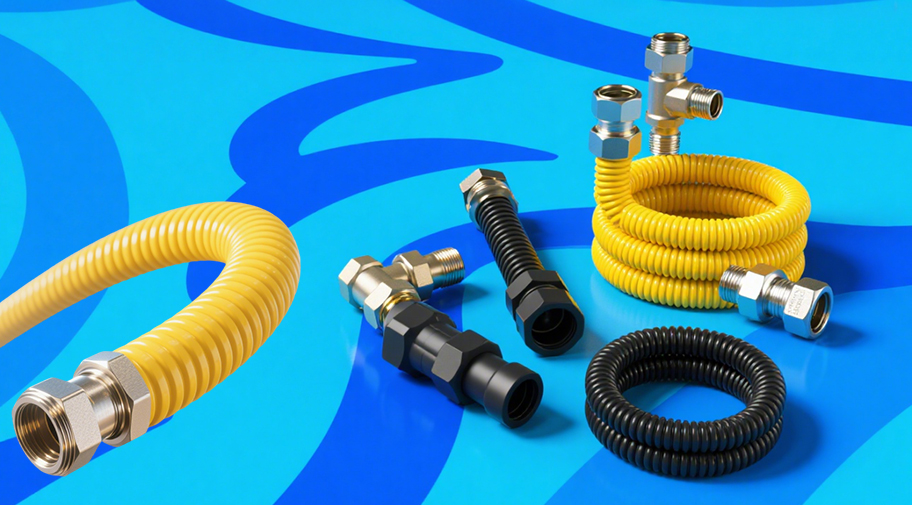
For residential and commercial gas systems, the same corrugated technology appears as a stainless steel flexible gas connector; the difference is context — a single-bend appliance connection instead of a multi-convolution expansion joint. The comparison between stainless steel bellows and rubber bellows usually comes down to temperature, pressure, fire safety, and ageing: rubber hardens and cracks over time, while stainless steel holds its rated performance for decades.
Where Bellows Systems Are Used
Across a plant, bellows systems appear in three different duties: as expansion joints, as gas connectors, and as flexible water lines. The geometry may look similar, but the rating logic differs, so matching the product to the duty is the first step.
Industrial piping and thermal loops
Steam, thermal oil, and hot-water loops grow with temperature. A flexible metal compensator with flanged ends absorbs axial and lateral movement at equipment nozzles and between fixed anchor points, protecting pump casings and heat exchanger flanges from thermal thrust. For cyclic services, specify the cycle life, not just the stroke.
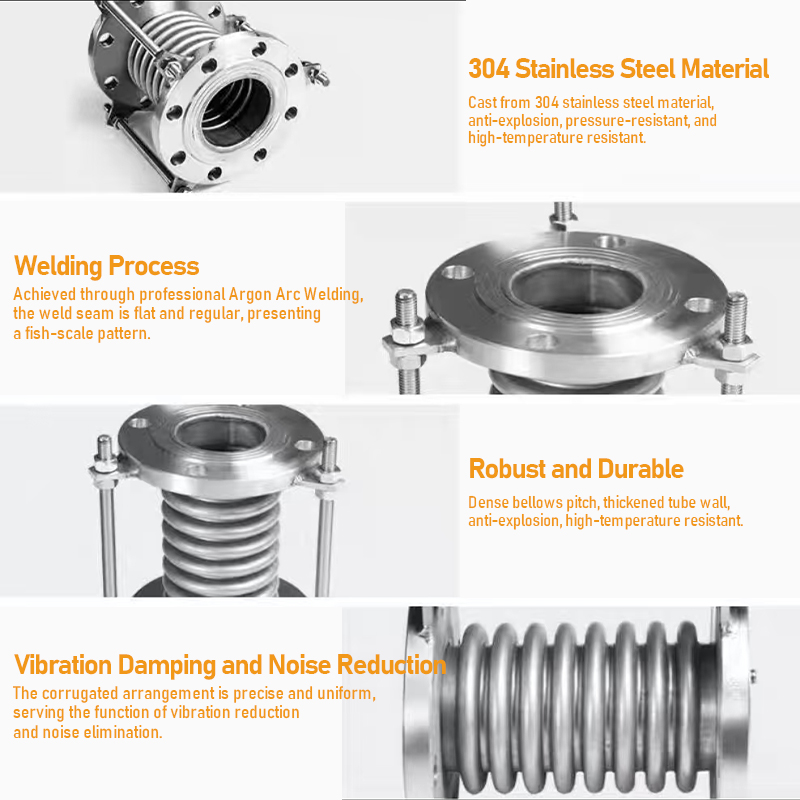 Flexible Metal Compensator Corrugated Expansion JointThis flanged or welded compensator absorbs axial and lateral movement from thermal expansion in steam, thermal oil, and hot-water systems, protecting pump casings and heat exchanger flanges. Its 304 stainless braid and pressure rating up to 1.6 MPa suit cyclic services.View Product →
Gas appliance and supply connections
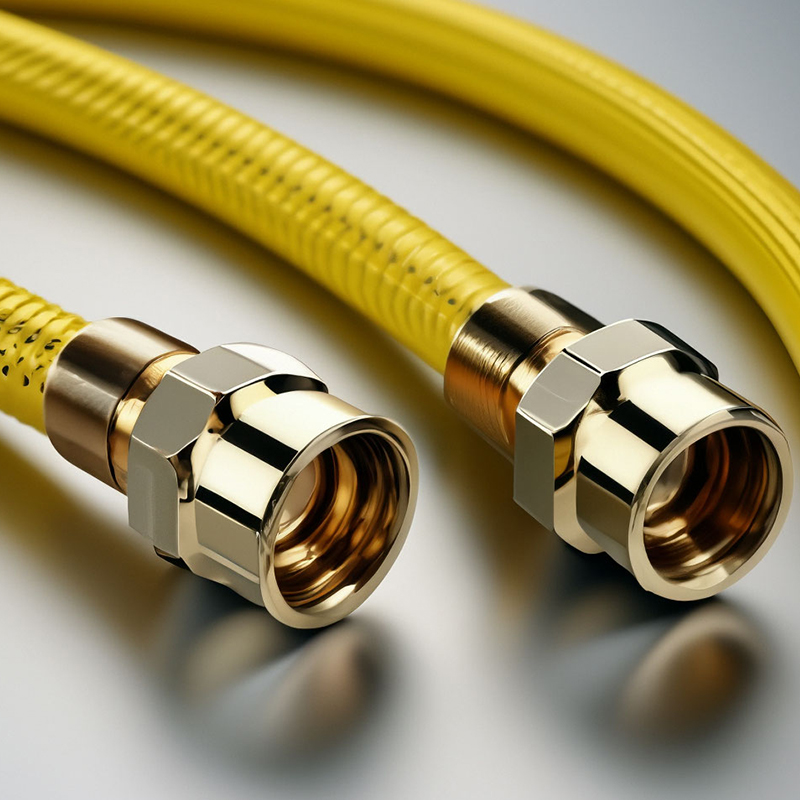
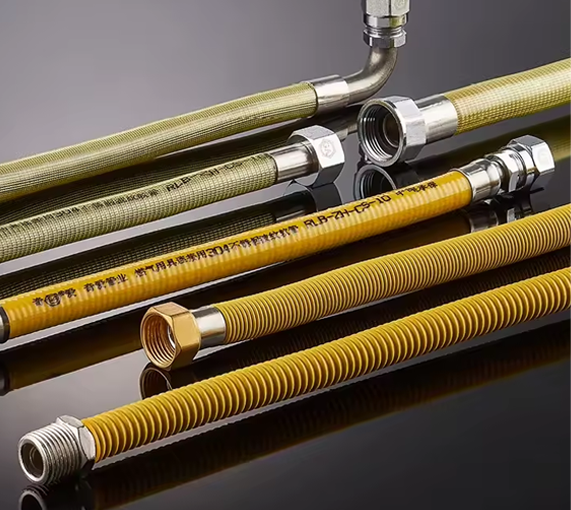
Corrugated stainless steel tube and semi-rigid gas connectors use the same corrugation principle to carry gas safely at low pressure while letting the appliance move for servicing. A CSA-certified stainless steel gas connector adds a standardized fitting and a factory leak test — a documented advantage when an inspector asks to see the rating.
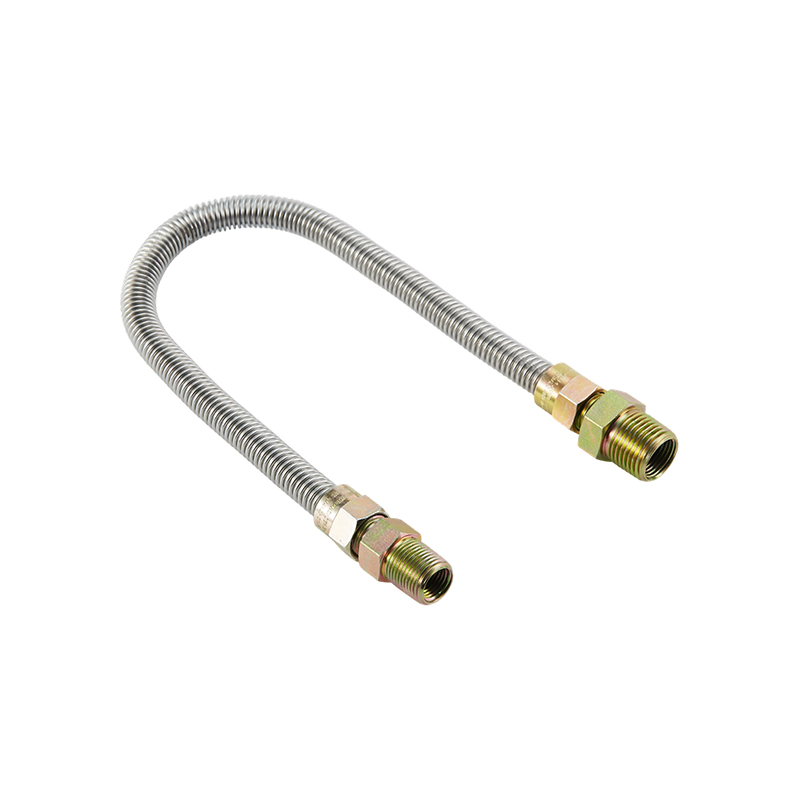 CSA-Certified Stainless Steel Gas Connectors (DN10–DN25)A range of CSA-certified stainless steel gas connectors with 304 material, 0.2–0.25 mm wall thickness, and 100% leak testing. Available sizes from DN10 to DN25 with flare nuts, suitable for residential and commercial gas appliances where inspector-rated documentation matters.View Product →
One common field complaint is whistling gas flow. The whistle comes from the flow pattern inside a smooth bore; a whistle-free gas connector uses a shaped inner core to suppress it while keeping the CSA-rated envelope and the flexibility of the bellows wall.
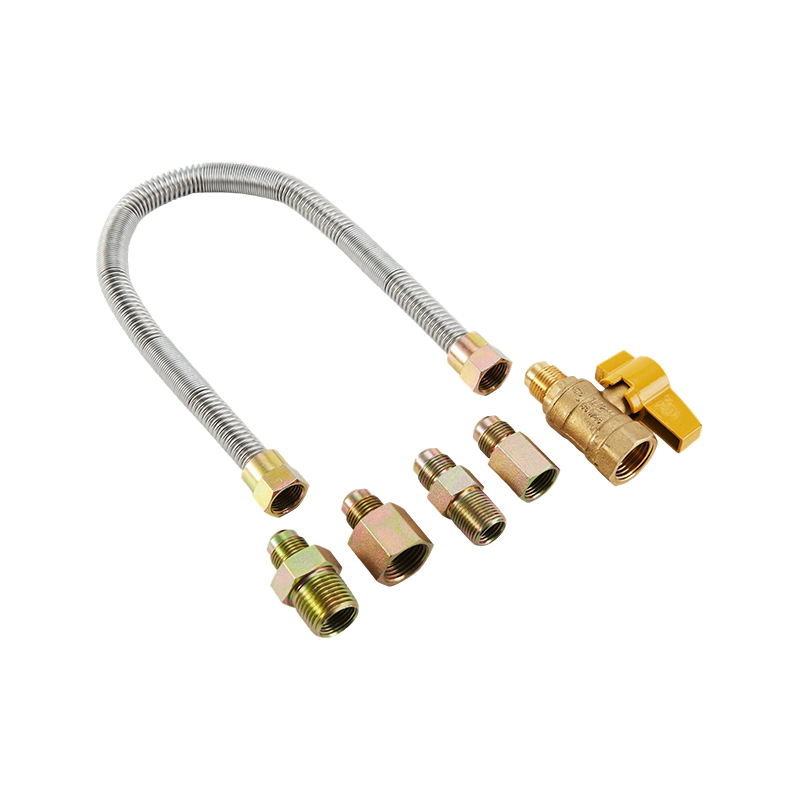 DN15 Stainless Steel Whistle-Free Gas ConnectorA DN15 connector with 0.25 mm wall thickness, 15/16"-16UNF flare nut, and various adapters. Its whistle-free core suppresses airflow noise while maintaining a hard seal with brass or carbon steel nuts, available in lengths from 12 to 72 inches for flexible installations.View Product →
Common Failures and How to Prevent Them
Most failed bellows systems fail from misuse, not from manufacturing. The list below reflects typical field experience in piping maintenance work, and each item maps directly to an installation rule.
- Over-extension beyond the rated stroke — the element bottoms out and yields the crown. Prevention: fit a travel stop or use a longer element.
- Torsion during installation — the bellows is twisted by a misaligned flange pair. Prevention: align the two flanges parallel before tightening.
- Water hammer or pressure surge — a sudden spike exceeds the rated envelope. Prevention: fit slow-closing valves and check transient pressure.
- Broken main anchors — when a neighbouring anchor fails, the bellows takes the full axial thrust and squirms. Prevention: inspect anchors annually and design for thrust from the start.
- Chloride corrosion — external chlorides from insulation or wash-down water crack 304 surfaces. Prevention: specify 316 or a protective cover where chlorides exist.
- High-frequency vibration at braid terminations — local fretting starts a crack. Prevention: move the bellows away from the source or add a damping support.
The mechanical background is covered in our note on why metal bellows fail in industrial pipelines. In short, three habits prevent most failures: respect the rated stroke, avoid torsion, and keep anchors in good condition.
How to Select a Bellows System: The Parameters That Matter
Selection starts with a line-by-line review of the duty, not with a catalogue number. Write down operating ranges, not averages: a bellows sized for average temperature but hit twice a day by a 20°C overshoot will fail early.
| Parameter | Why it matters | Practical note |
|---|---|---|
| Medium and corrosivity | Sets material grade and liner needs | H2S or chlorides change the alloy |
| Design temperature | Sets allowable stress and derating | Use the peak, not the average |
| Design pressure | Sets wall thickness and thrust loads | Include transient and surge pressure |
| Movement (axial, lateral, angular) | Determines convolution count and type | List all three, with direction and frequency |
| Cycle life required | Defines stress level per convolution | Count real thermal cycles per year |
| Anchoring available | Prevents squirm and over-thrust | Main anchors or tie rods required |
| End fitting type | Flange, weld end, or threaded nipple | Match the flange rating of the pipe |
| Space envelope | Limits length and pitch | Universal designs need more length |
Send these numbers to the manufacturer, and ask for the expected cycle life at your rated stroke, the spring rates, and the squirm pressure. A supplier who answers all three is quoting an engineered bellows system; one who answers only with a price is quoting a corrugated pipe.
Bellows System FAQ
Q1: What is a stainless steel bellows and how does a bellows system work?
A stainless steel bellows is a corrugated metal tube that flexes like a spring while containing pressure. In a system, it absorbs thermal expansion, vibration, and pipe movement so pumps, valves, and flanges stay within their design loads.
Q2: What is the difference between a bellows, a metal hose, and a rubber hose?
A bellows element is short and engineered for defined movement; a metal hose is longer and handles vibration and small displacements; rubber hoses are cheaper but age, crack, and cannot survive high temperatures or fire-risk service.
Q3: How long does a stainless steel gas connector or bellows last?
Life is measured in cycles, not years. A CSA-certified stainless steel gas connector installed without kinks typically lasts as long as the appliance. Expansion joints are rated for a cycle count per EJMA, often 1,000 to 100,000 cycles depending on stroke and pressure.
Q4: How do I know if a bellows system is damaged?
Look for creases, bulges, cracks, broken braid, and discoloration; measure the installed length against the original. If the element cannot return to its set length, or if a flex test shows stiffness, replace it before leakage occurs.
Q5: Can a bellows system absorb vibration and noise?
It isolates structure-borne vibration by adding flexibility between pipe supports. Whistling gas flow, however, needs a shaped inner core — that is what a whistle-free gas connector does — while a standard bellows handles the movement.
Q6: Do bellows and expansion joints need maintenance?
Yes: annual visual checks, anchor and tie-rod inspection, cleaning debris from convolutions, and logging cycles. Replace the element when it reaches its rated cycle count or shows any sign of cracking.