


Haoyin (Ningbo) Bellows Technology Co., Ltd.
  • TEL:

    +86-574-62166708
  • Fax:

    +86-18616887802
  • Address:

    No. 25 Gubei Road, Simen Town, Yuyao, Ningbo City, Zhejiang Province, China

Feel Free To Contact Us :

[email protected]

Our Products

Haoyin corrugated pipe, connecting the world's pipelines with professional expertise for the future. Green factories produce high-quality products, specializing in precision and showcasing new strength.

About

Haoyin (Ningbo) Bellows Technology Co., Ltd. is a professional enterprise specializing in the R&D, design, manufacturing, and sales of stainless steel bellows.

Service

Through our many years of professional experience, we provide you with comprehensive and considerate services

NEWS

Provide you with the latest enterprise and industry news.
+86-574-62166708
< DRAG>

Industry News

konw more about us

Home / News / Industry News / Bellows Pipe Selection Guide: Movement, Pressure, and Installation Risks

Bellows Pipe Selection Guide: Movement, Pressure, and Installation Risks

A maintenance technician finds a braided flexible line crushed against a pump flange. The line was installed to fix a small misalignment, but no one checked the movement direction, pressure thrust, or bend radius. Three months later, the braid strands begin to fail. The replacement is not simply a longer hose; it needs a properly specified bellows pipe or expansion joint.

The conclusion first: a bellows pipe is a pressure-containing flexible element, not a universal gap filler. Select it by movement type, pressure and temperature, medium, cycle life, and connection standard. Then confirm anchors, guides, and installation tolerances. If those points are not in the inquiry, the lowest-price quote is also the highest-risk quote.

What a Bellows Pipe Actually Does

In piping, “bellows pipe” usually describes a corrugated metal bellows assembly: a thin-wall stainless steel tube formed into convolutions, with end fittings, flanges, braid, or an inner liner. The corrugations flex so the pipe can absorb thermal growth, vibration, misalignment, or settlement without transferring the full movement to pumps, tanks, or rigid supports.

The common mistake is to treat pressure thrust as a secondary detail. Internal pressure acts on the effective area of the bellows and produces a force, roughly F = P x A. That force must be carried by anchors, guides, and the surrounding pipe structure. A bellows that is installed between two weak supports can absorb movement and still damage the system, because the force has to go somewhere.

DN50 1.96 kN DN80 5.03 kN DN100 7.85 kN DN150 17.67 kN 0 5 10 15 kN
Illustrative pressure thrust at 1.0 MPa using nominal bore area (F = P x A). Actual effective area must come from the bellows manufacturer’s data.

For larger lines, the expansion joint often requires a design calculation, not a catalogue-only selection. The calculation should cover pressure thrust, spring rate, movement direction, cycle count, and anchor loads. A small change in the effective area or installed length can change the load on a nozzle.
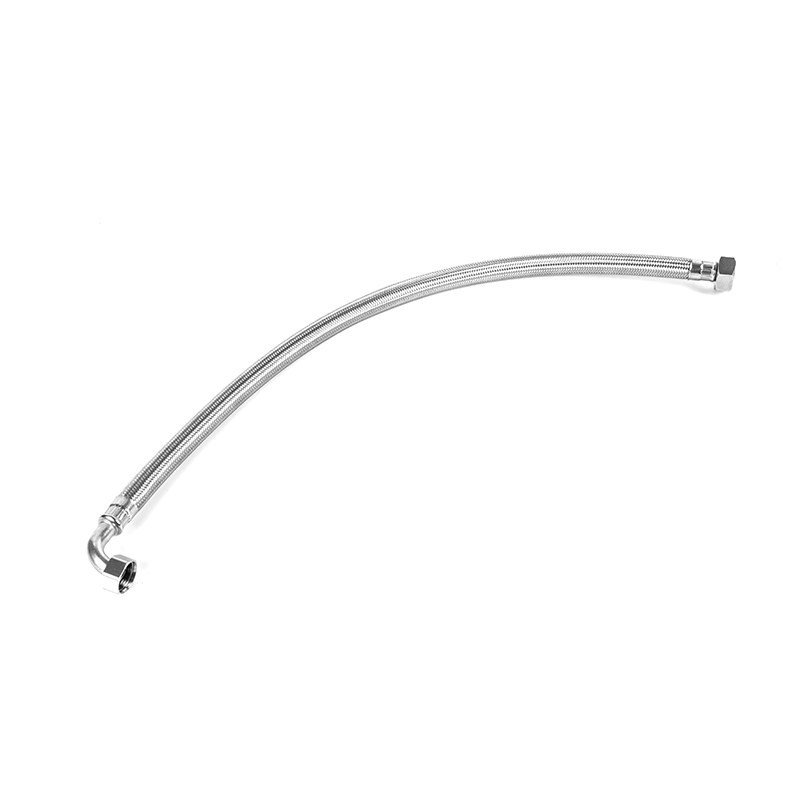
Flexible Metal Compensator Corrugated Expansion Joint for Larger LinesFlexible Metal Compensator Corrugated Expansion Joint for Larger LinesFor larger lines needing pressure-thrust and movement review, this expansion joint is offered in stainless or carbon steel with flange, welding, and quick-connect options.View Product →

A braided flexible hose uses the same principle at a smaller scale. The braid restrains pressure thrust and protects the bellows from over-extension, but it does not correct a permanent misalignment or remove the need for a proper bend radius. Different constructions, including formed, welded, and machined bellows, behave differently in fatigue and cost, so the drawing and the duty cycle matter.

Types and Configurations

Not all bellows pipe assemblies look alike. The differences affect movement capacity, pressure rating, and installation. A single axial unit is not a drop-in replacement for a universal joint, and a braided hose should not be ordered by length alone.

Common bellows pipe configurations and the points that usually decide the selection.
Configuration Best suited for What to check
Single axial expansion joint Axial thermal growth in a straight run Anchor and guide arrangement; pressure thrust; rated compression and extension
Universal expansion joint Combined axial and lateral movement Center pipe support; total length; lateral deflection and angular limits
Braided flexible hose Vibration, small misalignment, compact connections Braid coverage; minimum bend radius; torsion during tightening; end fitting material
Lined bellows Abrasive or high-velocity media where the bellows needs protection Liner attachment; flow direction; movement reduction caused by the liner

Selection Criteria That Matter in Procurement

A bellows pipe purchase should start with a data sheet, not a photo. For industrial piping, ask for a design calculation to EJMA, ASME B31.3, or EN 14917 as applicable. For gas connectors, CSA certification is a useful baseline in North American markets; it does not replace checking the actual appliance connection and local code.

Buyer checklist for a bellows pipe inquiry. Missing data usually returns as a commercial or safety problem later.
Requirement Ask for Why it matters
Design conditions Maximum and minimum pressure, temperature, and medium Sets material, wall thickness, and pressure rating
Movement Axial, lateral, and angular movement; design cycles Prevents selecting a joint that fits but fatigues early
Material 304 or 316L stainless steel, braid, liner, and end fitting Chlorides, condensate, and washdown can change corrosion risk
Connections DN size, flange standard, thread, face-to-face length Controls fit, gasket loading, and installation stress
Verification Calculation, test report, certification, and marking Gives the buyer a traceable basis for acceptance

The same discipline applies to small-bore gas and water lines. A stainless gas connector may look simple, but wall thickness, braid, nut material, and whistle-free bore can change the user experience. For a compact CSA-certified range, this gas connector category is one reference point.
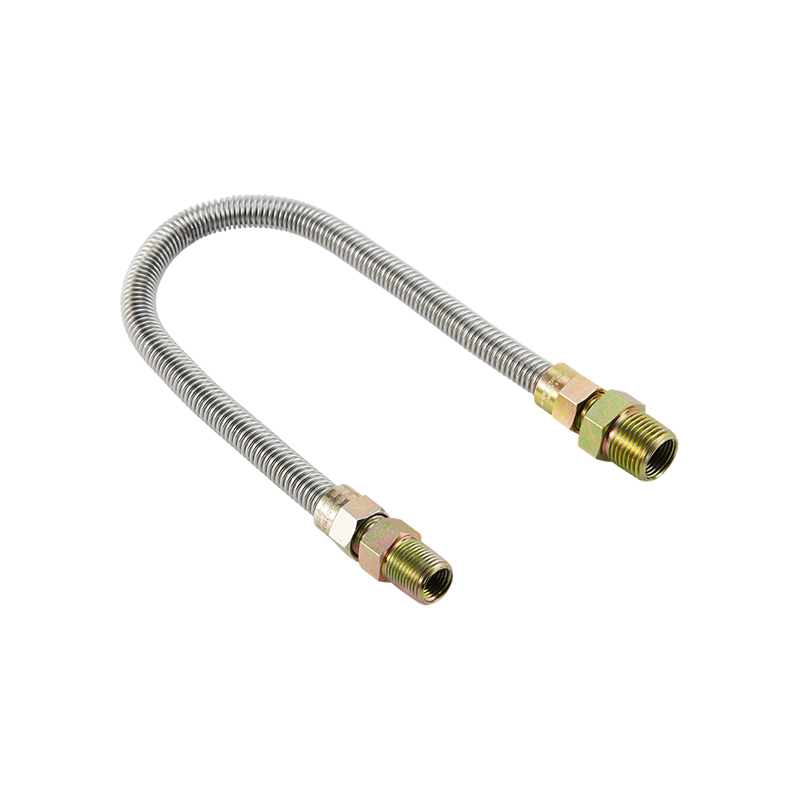
CSA-Certified Stainless Steel Gas Connectors for AppliancesCSA-Certified Stainless Steel Gas Connectors for AppliancesBrowse CSA-certified DN10–DN25 stainless gas connectors in multiple lengths for residential and commercial appliances, with wall-thickness and whistle-free options to compare.View Product →

Installation and Failure Modes

Most bellows failures are not mysterious. They come from torsion, over-extension, missing guides, or chloride attack. Do not use the bellows to pull two flanges together. Do not paint over the bellows or trap debris in the corrugations. Keep the flow direction correct where a liner is fitted.

axial movement Fixed anchor Bellows element Guide
Isometric-style view: a bellows pipe absorbs movement between anchored pipe sections; guides control lateral displacement and protect the bellows from torsion and over-extension.

Guides control lateral movement and prevent buckling; anchors take pressure thrust and movement reactions. If the line is hot, check the cold spring and installation temperature. If the line is buried or in a wet environment, review the external corrosion protection and drain path.

  • Axial compression beyond the rated stroke, often caused by anchor movement or ignored guide clearance.
  • Torsion during installation, especially when threaded connectors are tightened without a counter-hold.
  • Fatigue at the braid or end fitting from vibration without a proper bend radius.
  • Chloride stress corrosion in 304 stainless steel where 316L or a protective cover is needed.
  • Internal liner damage from reverse flow, high velocity, or abrasive particles.

Bellows Pipe vs Rigid Pipe and Rubber Hose

A rigid pipe is still the best choice for straight runs with enough loops and support. A rubber hose is useful for low-temperature water, easy movement, and quick service, but it has limited chemical and temperature range and can be damaged by sharp bends. A metal bellows pipe is preferred when temperature, pressure, chemical compatibility, or cycle life make rubber unsuitable.

The trade-off is engineering effort. Metal bellows can handle high temperature and pressure in a small footprint, but they are sensitive to installation errors and need correct anchors and guides. In gas connections, a stainless bellows connector can reduce the risk of kinking and rodent damage compared with a rubber hose, but only if the connector is correctly sized and certified for the application.

Frequently Asked Questions About Bellows Pipe

Q1: What is a bellows pipe used for?

A bellows pipe is used to absorb thermal expansion, vibration, misalignment, or settlement in a piping system while containing pressure. It is common in HVAC, gas, water, and industrial pipework.

Q2: Is a bellows pipe the same as an expansion joint?

A bellows pipe may be the flexible element inside an expansion joint. The expansion joint is usually the complete assembly, including bellows, end fittings, and sometimes a liner, braid, or limit rods.

Q3: How do I choose the right bellows pipe size?

Start with DN or actual outside diameter, pressure, temperature, medium, movement, and connection type. Then check the face-to-face length, bend radius, and required cycle life before ordering.

Q4: Can a bellows pipe handle high temperature and pressure?

Metal bellows can handle demanding service, but the rating depends on material, wall thickness, convolution shape, braid, and end fittings. Ask for a pressure and temperature rating plus the design calculation.

Q5: How long does a stainless steel bellows pipe last?

There is no fixed service life. Fatigue cycles, corrosion, vibration, and installation quality decide the outcome. For critical lines, request fatigue data and a cycle-life review rather than relying on a generic estimate.

Q6: How do you install a bellows pipe correctly?

Align the flanges without pulling with the bellows, avoid torsion, respect the bend radius, fit anchors and guides as designed, and keep paint and debris out of the corrugations. Follow the flow direction where a liner is used.

A bellows pipe does a simple job under difficult conditions: it moves where rigid pipe cannot. The safe choice is the one supported by pressure thrust, movement, material, and installation data, not just the one that fits the gap on site.
Latest Articles

  • Jul 09,2025

    Haoyin (Ningbo) Bellows Technology Co., Ltd.

    Haoyin (Ningbo) Bellows Technology Co., Ltd. is a professional enterprise specializing in the R&D, design, manufacturing, and sales of stainless steel bellows. It is committed to providing safe, efficient, and durable flexible connection solutions for gas, plumbing, heating, and other fields. Covering an area of 35 mu, the company has 18,000 square meters of standardized workshops and has obtained multiple management system certifications, such as ISO9001, ISO14001, and ISO45001.
    As a "National High-tech Enterprise" and "Green Factory", Haoyin has always adhered to the production philosophy of "Striving for Excellence, Forging Quality". It has built a full-process quality management system from raw material screening, structural design, manufacturing, performance testing to after-sales support, continuously creating higher value for customers.
  • Jul 09,2025

    Say goodbye to rubber hoses! How can stainless steel bellows eliminate the risk of gas leakage?

    1. Hidden dangers of rubber hoses: Why must they be eliminated?

    Traditional rubber hoses have the following fatal defects:

    Easy to age: They will harden, crack, and lose their sealing properties in about 2 years.
    Not resistant to high temperatures: They are easily deformed by long-term heat, increasing the risk of leakage.
    Afraid of rat bites: Rubber materials are easily bitten by rats, causing gas leakage.
    Unstable connection: The clamp is not firmly fixed and is easy to loosen and fall off.


    2. Four major safety advantages of stainless steel below

    ① Super corrosion resistance, lifespan of up to 8-10 years

    Using 304/316 stainless steel, it is corrosion-resistant and oxidation-resistant, and is not affected by kitchen fumes and humid environments. Its service life far exceeds that of rubber hoses (national regulations require that gas connection pipes be used for no less than 8 years).


    ② Explosion-proof and pressure-resistant, high and low temperature resistant

    Temperature range: -20℃ to 150℃, suitable for various environments.

    Strong pressure resistance: can withstand pressure above 0.4MPa, which is much higher than the household gas standard (0.01-0.1MPa).


    ③ Anti-rat bite and anti-fall design

    Metal braided layer: cannot be bitten by rats, eliminating the risk of animal damage.

    Threaded interface: a metal nut + sealing gasket is used, which is more firmly fixed than the clamp of the rubber tube.


    ④ Flexible and bendable, easy to install

    Stainless steel bellows have a certain flexibility and can adapt to different installation angles to avoid stress problems caused by hard pipe connection.


    3. How to correctly purchase and install stainless steel bellows?
    Purchase points

    Recognize the national standard: choose products that meet the GB/T 26002-2020 standard.

    Material selection: 304 stainless steel (sufficient for home use) or 316 stainless steel (more corrosion resistant).

    Suitable length: not too long (generally not more than 2 meters) to avoid bending and affecting airflow.


    Installation precautions

    Must be installed by professional gas company personnel and cannot be operated by yourself.

    Check the sealing: After installation, use soapy water to check whether the interface is leaking.

    Regular inspection: Check the pipeline status every 1-2 years to ensure that there is no deformation or rust.


    4. Stainless Steel Bellows FAQ (Frequently Asked Questions)
    Will the stainless steel bellows leak?

    Rarely leaks if properly installed:

    The threaded thread + sealing gasket is used, which is more secure than the clamp of the rubber tube;

    It must be installed by professionals of the gas company and the sealing must be tested with soapy water.


    Can you install the stainless steel below?

    Self-installation is prohibited!

    Gas pipelines involve safety and must be operated by licensed gas company personnel.

    Self-installation may cause leakage or even an explosion.


    Can the stainless steel bellows be bent?

    It can be bent moderately, but repeated bending is prohibited:

    The natural curvature must be maintained during installation to avoid right-angle bending that affects the airflow.

    Excessive bending may cause metal fatigue and reduce the service life.

  • Jul 09,2025

    Safety first choice: Why is metal spiral hose recommended for gas appliances?

    Gas safety is an important part of family life that cannot be ignored, and the hoses connecting gas stoves, water heaters, and other appliances are directly related to gas safety. In recent years, metal spiral hoses have gradually replaced traditional rubber hoses and become the choice for gas connections. Why do professional organizations and gas companies recommend the use of metal spiral hoses? What are its advantages?

    1. Hidden dangers of traditional rubber hoses
    Before the popularity of metal spiral hoses, families used rubber hoses to connect gas equipment. However, rubber hoses have many safety hazards:

    Easy to age and crack: Rubber is exposed to the kitchen environment for a long time, affected by high temperature, oil smoke, humidity, etc., and is prone to harden and crack, causing gas leakage.
    Easy to be damaged by rat bites: The rubber material may be bitten by rats, causing damage and leakage, which can lead to safety accidents.
    Short service life: National standards stipulate that the service life of rubber hoses shall not exceed 18 months, but many families use them beyond the expiration date, increasing the risk.
    Poor pressure resistance: The rubber hose has a low pressure bearing capacity. If the gas pressure fluctuates greatly, it may rupture.

    These shortcomings have led to the gradual replacement of rubber hoses with safer metal spiral hoses.

    2. Advantages of metal spiral hoses
    Metal spiral hoses are made of 304 stainless steel wire braided layer + corrosion-resistant synthetic materials, which have significant advantages over rubber hoses:

    l Super corrosion resistance and high temperature resistance
    The stainless steel outer layer can resist the erosion of kitchen fumes and humid environments, and does not easily age.
    It has high temperature resistance and can withstand temperature changes from -30℃ to 150℃, suitable for various gas equipment.
    l Anti-rat bite and anti-wear
    The metal braided layer can effectively prevent rats from biting and avoid accidental damage.
    The outer metal protection makes the hose more wear-resistant and less likely to leak due to friction.
    l Pressure-resistant and explosion-proof, good sealing
    The metal spiral structure enhances the pressure-bearing capacity, can withstand higher gas pressure, and reduces the risk of leakage caused by pressure fluctuations.
    The threaded interface + sealing gasket is more secure than the snap-on connection of the rubber hose to prevent falling off.
    l Long service life
    The service life of metal spiral hose can reach 8-10 years, far exceeding the 18 months of rubber hose, reducing the trouble of frequent replacement.


    3. How to purchase and install correctly?
    Although metal spiral hose is safer, you still need to pay attention to the following when purchasing and installing:

    Recognize national standards: Choose products that meet GB/T 26002 or CJ/T 197 standards to ensure quality.
    Matching interface type: The interface of gas stoves and water heaters may be threaded or quick-insert, which needs to be confirmed before purchase.
    Moderate length: The hose should not be too long (generally not more than 2 meters) to avoid bending that affects airflow.
    Professional installation: It is recommended to be installed by a gas company or a certified technician to ensure that the interface is sealed and leak-free.

    4. What should be noted when using metal winding hoses?
    Regular inspection and replacement
    Leak detection method: Apply soapy water to the interface after installation and regularly to observe whether bubbles appear.
    Aging signs: If cracks, rust, hardening, or loose joints are found, stop using and replace immediately.
    Replacement cycle: Even if there is no damage, it is recommended to replace it every 2-3 years.

    Use taboos
    No wall penetration/hidden burial: The hose must be installed openly and cannot be hidden in the wall or cabinet to prevent leakage from being difficult to detect.
    Refitting is prohibited: The interface must not be cut off, lengthened, or modified by yourself.
    Adapter: Only for designated equipment, such as gas stoves and water heaters, not for high-pressure or non-gas scenes.

    Emergency treatment of leakage
    When a gas leak is found, immediately close the main valve, open the window for ventilation, do not touch the electrical switch, and go outside to call the emergency repair phone.