




 English
 Español
 русский



A fitter who has just stretched a braided connector 40 mm to reach a hob valve is already outside the design envelope, and the leak test he runs five minutes later will not tell him that.
The short answer: a 304 stainless steel flexible gas connector is a corrugated austenitic stainless tube, wrapped in a braided 304 wire sleeve and terminated with crimped or welded fittings. It is the sensible default for indoor appliance and light commercial gas connections because it bends without kinking, absorbs vibration and does not perish the way rubber does. What keeps it safe is not the grade alone: bore size, assembly length, certification scope and installation practice decide the outcome, and 316L should replace 304 wherever chlorides are present.
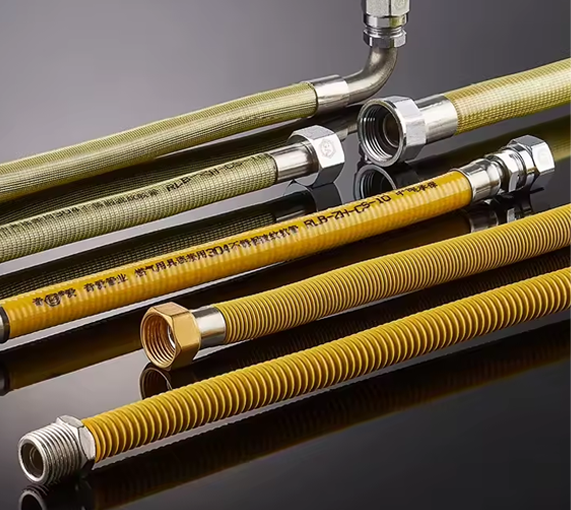
How a 304 Stainless Steel Flexible Gas Connector Is Built
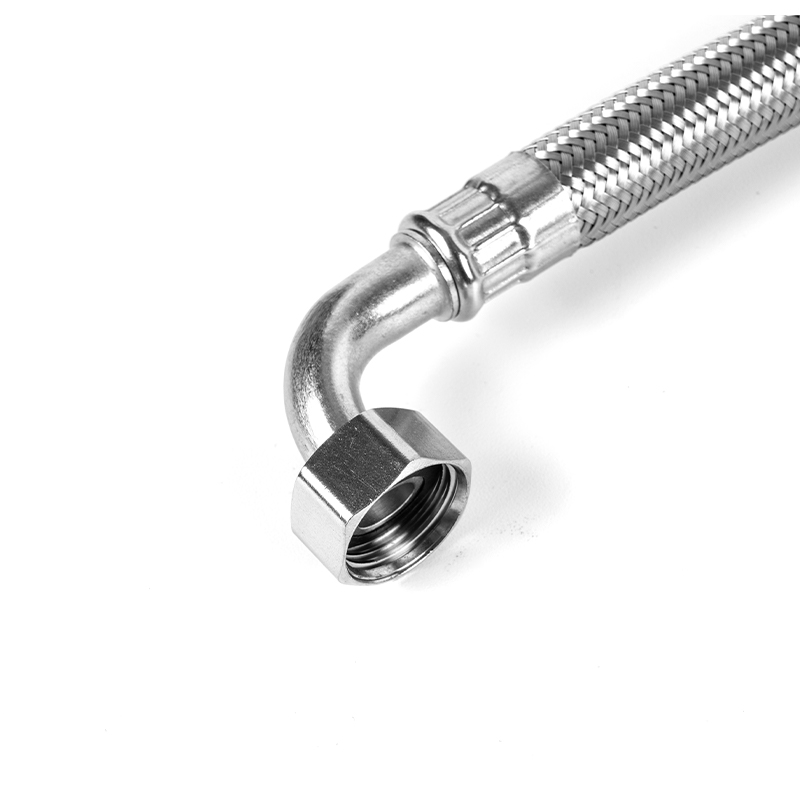
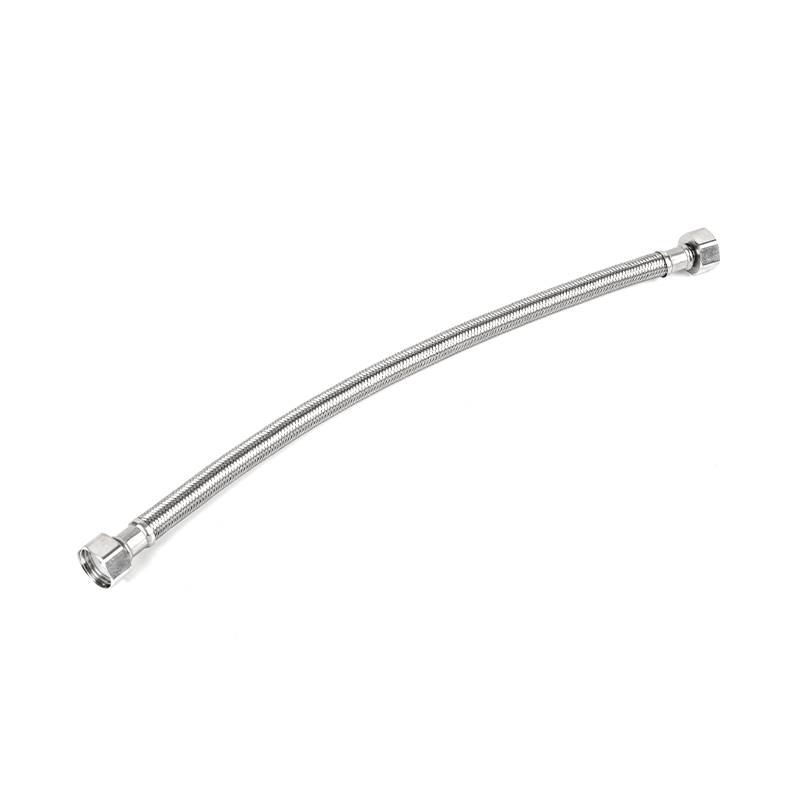
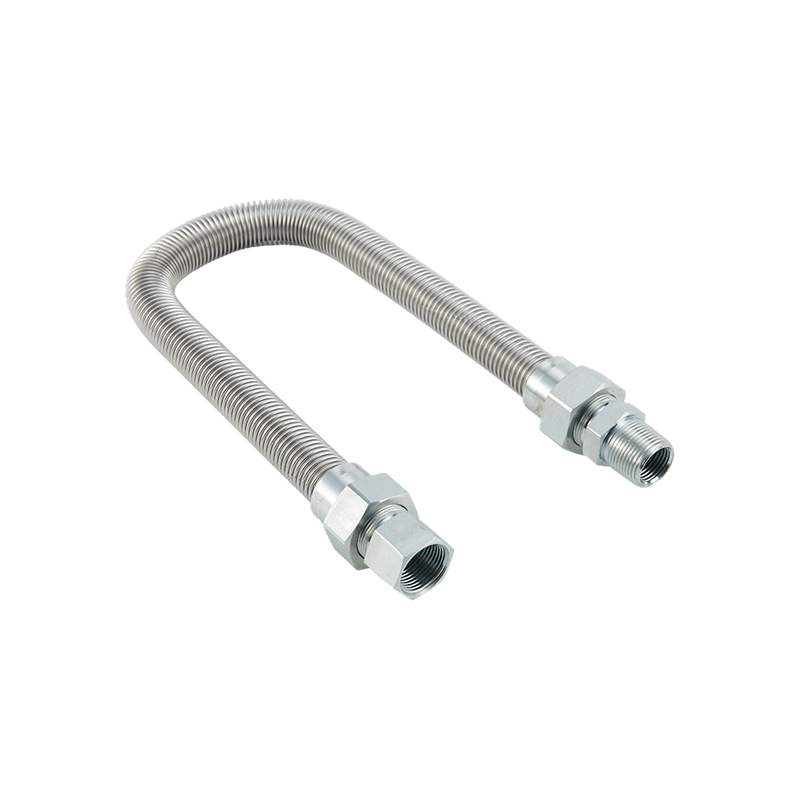
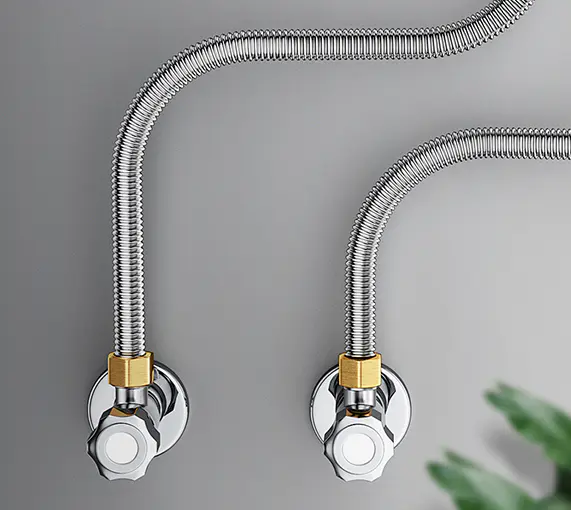
Production starts with 304 strip, rolled into a tube, seam-welded and then corrugated. Annular corrugation gives a tight bend radius in a short length; helical corrugation spreads flexibility over a longer run. The wall is thin, typically 0.2 to 0.3 mm, so the corrugation profile is what allows the assembly to flex instead of the material stretching. A braided sleeve of fine 304 wires is then pulled over the core. The braid carries hoop and longitudinal loads and shields the corrugation from abrasion.
The end fittings decide service life as much as the tube does. Ferrules are crimped or welded, and nuts are brass, nickel-plated brass or 304. The finished assembly is annealed after forming to relieve work-hardening, then pressure and leak tested before packing. Useful references are ISO 10380 for corrugated metal hose, EN 14800 for gas hose assemblies in Europe, and ANSI Z21.24 or CSA in North America. If you want the layer-by-layer anatomy, this guide on what a stainless steel flexible gas connector actually consists of walks through it in more detail.
Where 304 Performs Well and Where It Should Not Be Used
304 is roughly 18% chromium and 8% nickel, austenitic and non-magnetic in the annealed state. It resists oxidation and handles odourised natural gas and LPG without difficulty, at temperatures far below its service limit. Indoors, downstream of the regulator, it is a sound and economical choice.
It is not the answer everywhere. Chlorides are the weak point: coastal kitchens with salt-laden air, splash zones from chlorinated water, pool plant rooms, ammonia refrigeration areas and some chemical plants will pit 304 given time, and the braid usually shows it first. 316L, with 2 to 3% molybdenum, is the standard upgrade. If a coastal project still specifies 304, ask for salt-spray evidence to ASTM B117 rather than accepting a verbal assurance, and be clear about what you are looking at: surface rust from free-iron contamination is common and does not always mean the braid is failing, but you should know which of the two you have.
Dry indoor appliance work: 304 is appropriate and cost-effective.
Coastal, chlorinated or ammonia service: specify 316L, and verify the braid material on the certificate.
Certificate scope: if the document does not list the DN you ordered, it does not cover it.
Sizing from DN10 to DN25: Bore Matters More Than the Thread
Conclusion first: choose the bore from the appliance gas input and the permitted pressure drop, then choose the thread. A half-inch nut says nothing about the bore behind it, and a DN10 core feeding a high-input commercial range is a whistle and a pressure complaint waiting to happen.
| Size | Nominal bore | Typical duty | Flow area index |
|---|---|---|---|
| DN10 | 10 mm | Single small burners, patio heaters, low-input decorative fires | 100 |
| DN12 | 12 mm | Domestic hobs and cooktops, small water heaters | 144 |
| DN15 | 15 mm | Standard domestic hob, oven, boiler and gas fire connections | 225 |
| DN20 | 20 mm | High-input domestic boilers, dryers, small commercial cooking | 400 |
| DN25 | 25 mm | Commercial ranges, multi-appliance manifolds, larger boiler drops | 625 |
Two practical notes. First, doubling the bore quadruples the flow area, so the step from DN10 to DN15 is far bigger than the numbers suggest. Second, keep the assembly as short as the installation allows: a long connector looped to take up slack adds pressure loss, traps debris and looks like an error to any inspector.
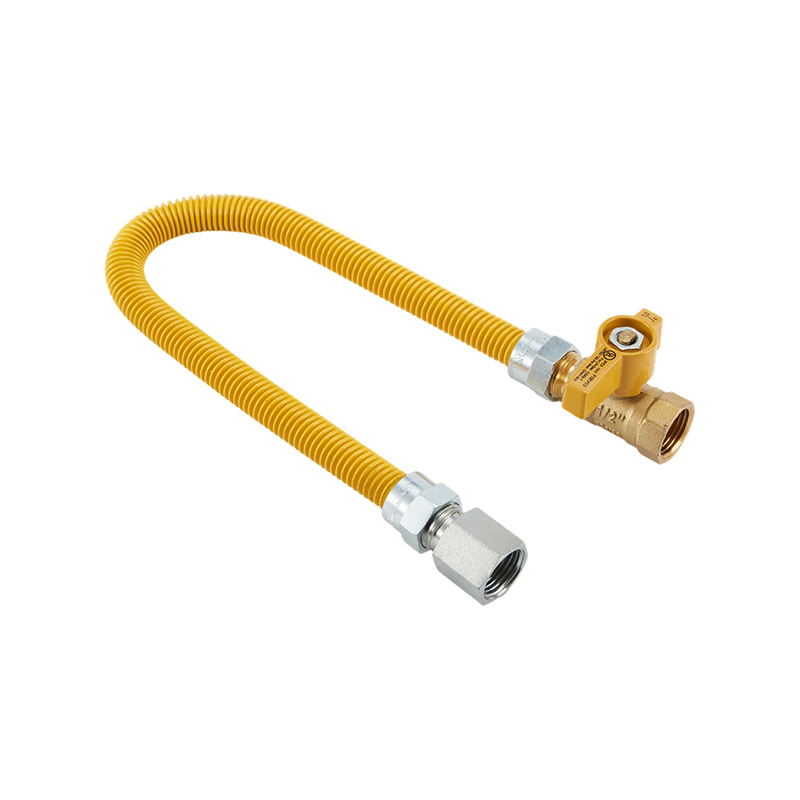
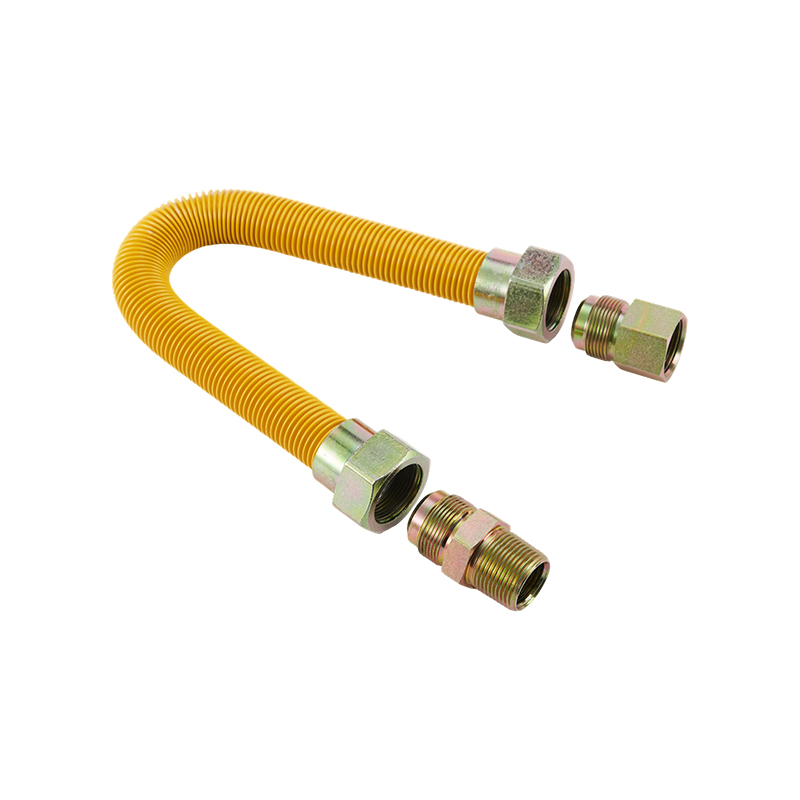
For the most common domestic case, a hob, oven or boiler on a half-inch connection, a CSA-certified DN15 assembly is the usual specification:
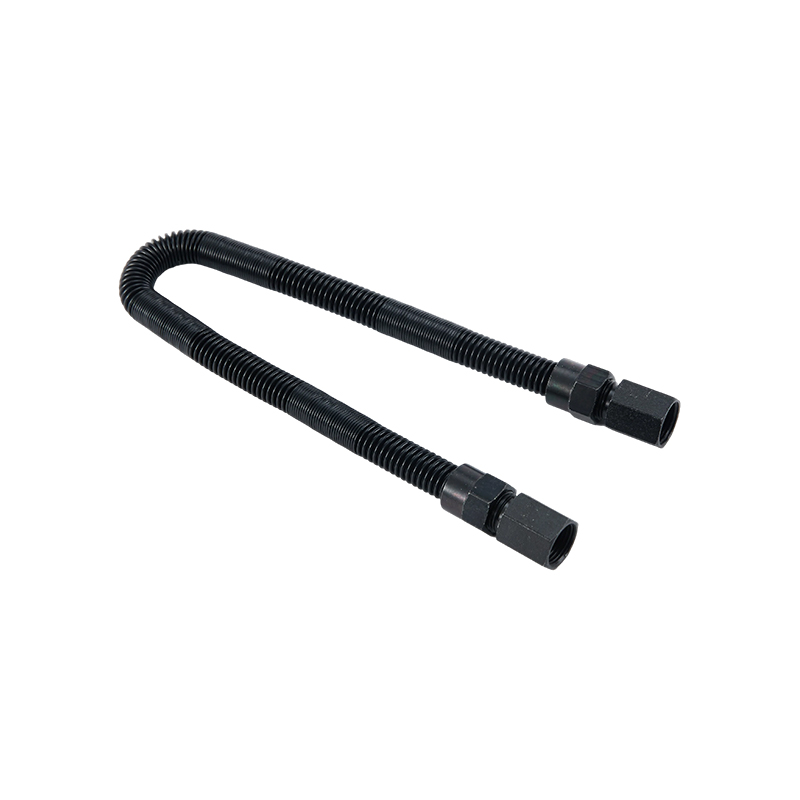 CSA-Certified DN15 Stainless Steel Gas ConnectorA CSA-certified DN15 304 stainless connector with 15/16–16UNF flare nut, multiple adapters and hard-seal design for common domestic gas appliance connections.View Product →
Whistle-Free Connectors and the Noise Complaint
A whistling connector is almost always a flow-velocity problem rather than a defect. Gas accelerates through an undersized bore or a sharp internal step, and the corrugation can amplify the tone until it is audible in the next room. Before changing parts, check the bore against the appliance input and confirm the isolation valve is fully open; a partly closed valve produces exactly the same symptom.
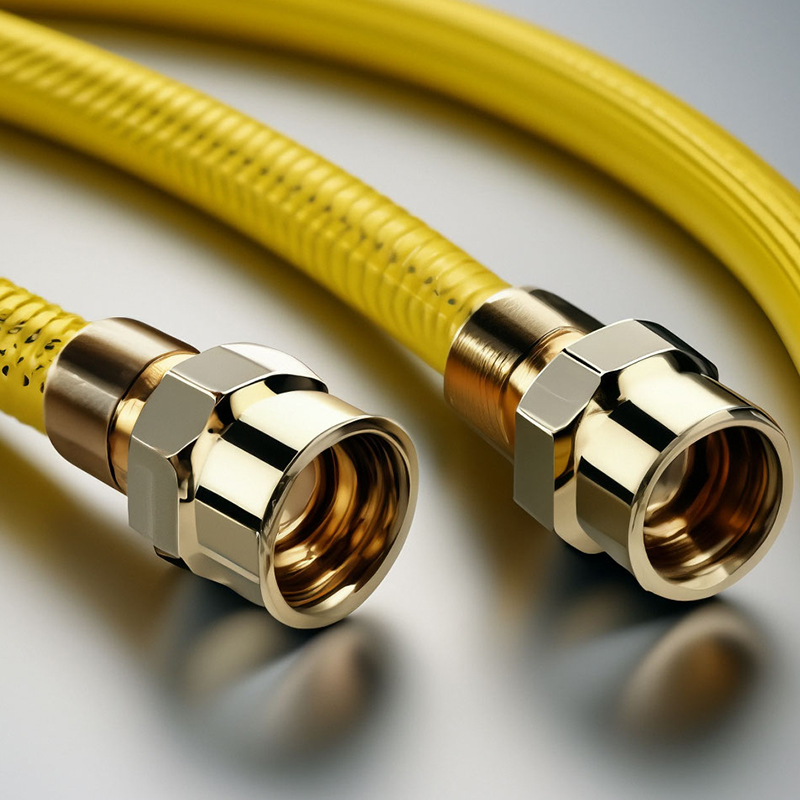
Where the bore is correct and the noise persists, a whistle-free connector with a smoothed internal flow path is the practical fix, and it is usually cheaper than a call-back. On higher-input installations the same design logic applies at a larger bore:
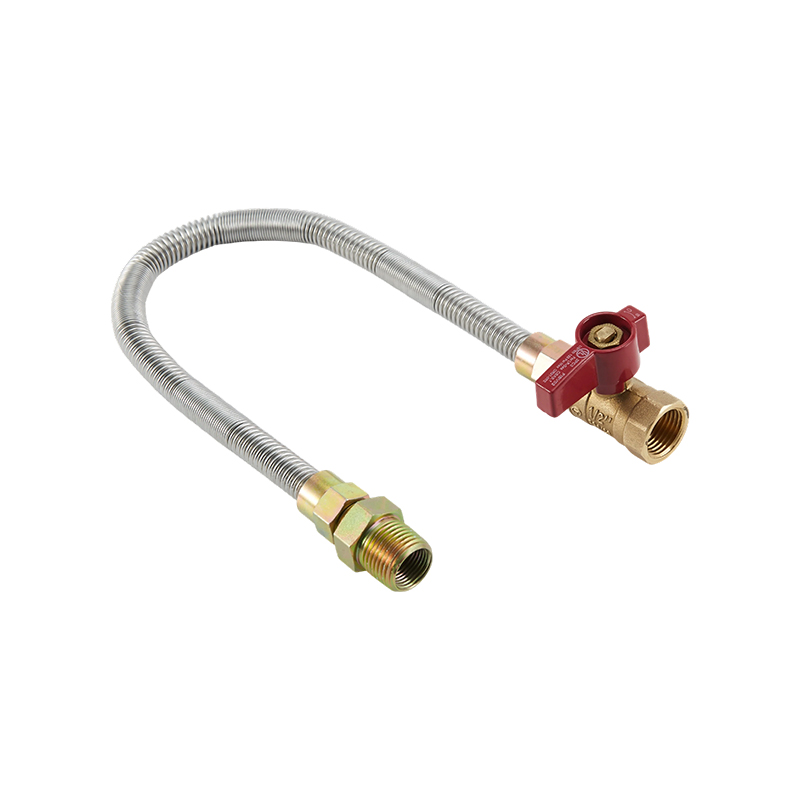 DN20 Whistle-Free Stainless Steel Gas ConnectorA DN20 304 stainless connector with 1 1/8–16UNF flare nut, adapter options and hard-seal design; its whistle-free flow path reduces noise on higher-input installations.View Product →
Installation Limits That Cause Most Field Failures
- Minimum bend radius is a hard limit. A tight 90-degree turn at the ferrule work-hardens the corrugation and starts a fatigue crack.
- Never use the connector to pull components together. Tension loads the braid and the ferrule takes the strain.
- Support the assembly. A connector carrying its own weight plus a valve is a long-term fatigue test.
- Keep it clear of hot surfaces and flue paths. The tube is stainless; the jacket and fittings are not.
- Do not re-use after an appliance move. A crimp is not designed to be remade and re-seated.
- Leak-test with soap solution or a detector, never a flame, and check both ends plus every joint you disturbed.
- Torque to the published figure with a backing spanner. Over-torque distorts the seat; under-torque leaves a leak path.
- Do not paint, solvent-wipe or cement-coat the braid. Chlorinated and solvent residues are exactly what 304 does not want.
What to Check Before You Place the Order
Industry guidance consistently points to installation error and mechanical damage, not tube failure, as the leading cause of connector leaks, which is why procurement checks should focus on documentation as much as on the part.
- Certificate scope. A certificate listing DN10 and DN12 does not automatically cover the DN25 you just added to the purchase order.
- Dimensional tolerances. Agree bore tolerance, length tolerance and nut thread gauge in writing before the first shipment.
- Material documentation. Ask for EN 10204 3.1 certificates for the strip and braid wire, and match the heat numbers to the batch.
- Test records. Pressure and leak test data, plus ferrule pull-off or torque results, should be available on request.
- Corrosion evidence. For coastal projects, request salt-spray hours rather than a verbal claim.
- Packaging. Capped ends, protected braid and undamaged coils prevent the damage that shows up as a complaint six weeks later.
Sourcing from a corrugated pipe manufacturer that controls strip selection, corrugation, braiding and crimping under one roof removes many of these questions. Haoyin (Ningbo) Bellows Technology, for example, produces CSA-certified gas connectors from DN10 to DN25 in an 18,000 m² plant in Yuyao, with a stated monthly output above 300,000 metres. For commercial ranges and manifold drops, the larger bore is the one to specify:
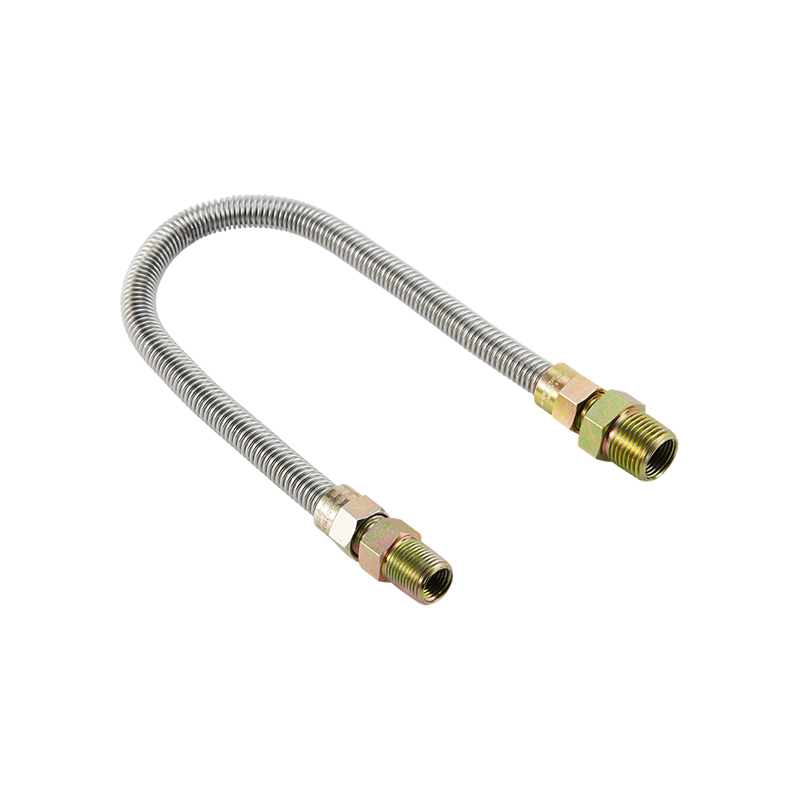 CSA-Certified DN25 Stainless Steel Gas ConnectorA CSA-certified DN25 304 stainless connector in 12–72 inch lengths, with brass or carbon steel nuts for commercial ranges and manifold drops.View Product →
FAQ: 304 Stainless Steel Flexible Gas Connectors
What is a 304 stainless steel flexible gas connector used for?
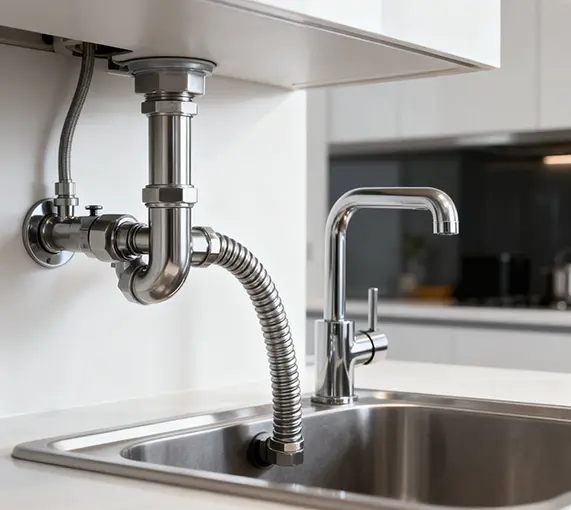
It links a fixed gas supply pipe to an appliance such as a hob, oven, boiler, water heater or commercial cooking unit, where rigid pipe cannot absorb movement, vibration or small misalignment. The corrugated 304 core carries the gas and the braid carries the load.
What size gas connector do I need for my appliance?
Match the bore to the gas input, not to the thread. DN15 covers most domestic hobs, ovens and boilers; DN10 and DN12 suit low-input appliances; DN20 and DN25 are for high-input boilers, ranges and manifold connections.
Is 304 or 316 better for a flexible gas connector?
Use 304 for dry indoor installations. Specify 316L for coastal sites, chlorinated or ammonia environments, and anywhere salt spray can reach the braid.
How long does a stainless steel flexible gas hose last?
Installed indoors within its bend radius, a braided 304 assembly is normally expected to serve for the life of the appliance installation. Heat exposure, kinking at the ferrule and re-use after an appliance move are what shorten that.
Why is my gas connector whistling?
Usually flow velocity: an undersized bore for the appliance input, a partly closed valve, or a sharp internal step. Confirm the bore first, then move to a whistle-free connector if the noise continues.
What does CSA certification on a gas connector confirm?
That the assembly has been type-tested by a recognised body against the applicable gas connector standard, for the sizes and design listed on the certificate. Always check that your DN appears on that list.