




 English
  Español
  русский


Quick Answer: How To Determine The Correct Gas Connector Size
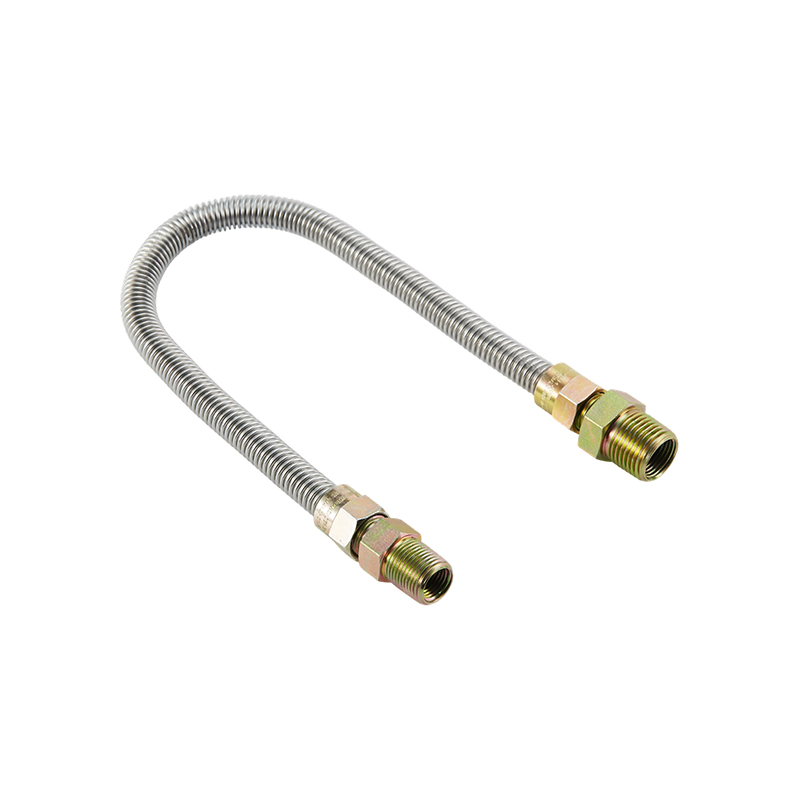
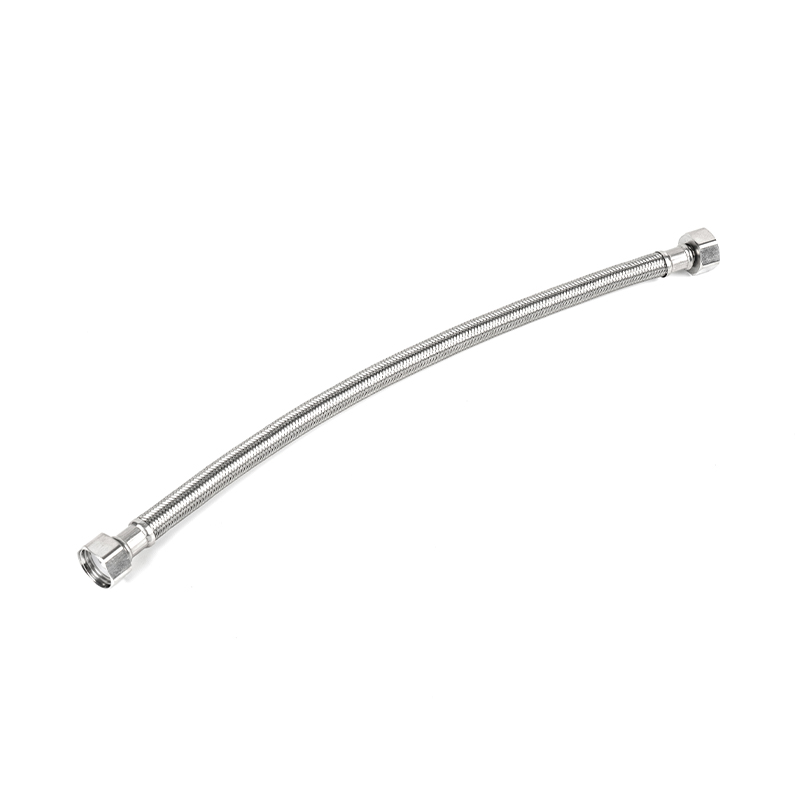
The correct size for a Stainless Steel Flexible Gas Connector is set by the inlet fitting on the appliance and the outlet fitting on the gas shutoff valve, not by the size of the branch gas line feeding the room. Connectors are labeled by a nominal size, and the two sizes used on most household appliances are 3/8 inch and 1/2 inch, while 3/4 inch and 1 inch sizes are generally reserved for higher input appliances such as large water heaters and furnaces. To choose the right size, match the female fitting on each end of the connector to the thread size stamped on the appliance valve and on the shutoff valve, then confirm that the rated input capacity of that nominal size is equal to or greater than the maximum BTU per hour figure printed on the appliance rating plate.
A stainless steel flexible gas connector for stove installations is most commonly sized at 1/2 inch, while many compact or portable cooking appliances use a smaller 3/8 inch connection. Larger commercial style ranges and combination units sometimes call for a 3/4 inch fitting, so the appliance nameplate should always be checked before ordering a replacement connector.
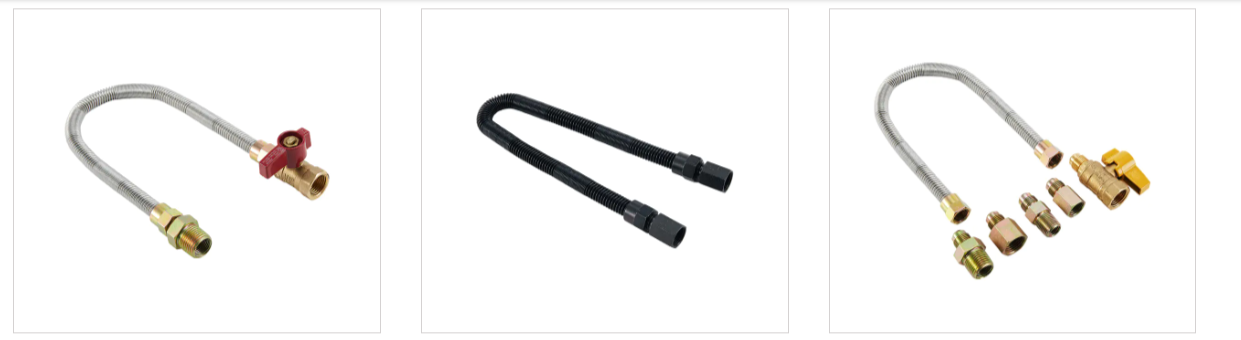
Why Correct Sizing Matters For A Stainless Steel Flexible Gas Hose
An undersized connector restricts gas flow to the appliance, which can lead to weak burner performance, slow water heater recovery, or an appliance that struggles to reach its rated output. An oversized connector, on the other hand, will not thread correctly onto the appliance valve or the shutoff valve, and forcing a mismatched fitting can damage the thread on both the connector and the valve. Because appliance input ratings vary between brands and models, the nominal size that worked on an old unit is not automatically correct for its replacement, so the rating plate should be checked every time an appliance is swapped out.
This differs somewhat from how a csst gas connector system is sized. A CSST gas connector is typically part of a continuous run of corrugated stainless steel tubing that distributes gas from a meter or manifold to multiple appliances throughout a structure, so its size is calculated from the total connected load and the length of each run using a sizing chart, rather than from a single appliance fitting. A stainless steel flexible gas hose used purely as an appliance connector, by contrast, only needs to match the two fittings it sits between.
Common Nominal Sizes And Appliance Match-Up
The table below summarizes how nominal connector sizes typically line up with common household gas appliances. These figures are general references, and the exact maximum input rating stamped on the appliance nameplate should always take priority over any general chart.
| Nominal Size | Typical Appliance | Common Thread Connection | Approx. Max Input |
|---|---|---|---|
| 3/8 inch | Compact stove, portable cooktop | 3/8 inch FIP | About 40,000 BTU/hr |
| 1/2 inch | Gas range or stove, gas dryer | 1/2 inch FIP | About 75,000 BTU/hr |
| 3/4 inch | Gas water heater, gas furnace | 3/4 inch FIP | About 150,000 BTU/hr |
| 1 inch | Large furnace, manifold feed | 1 inch FIP | About 300,000 BTU/hr |
Approximate Maximum Input By Nominal Connector Size
Figure 1. Approximate maximum appliance input associated with each nominal connector size.
Stainless Steel Flexible Gas Connector Compared With CSST And PVC Coated Options
Buyers often need to decide between a bare Stainless Steel Flexible Gas Connector, a longer run csst gas connector, and a PVC Coated Gas connector. All three share the same corrugated stainless steel core, but they are built and finished for different roles. The table and chart below outline how these three options generally compare on function rather than on price.
| Feature | Stainless Steel Flexible Gas Connector | CSST Gas Connector | PVC Coated Gas Connector |
|---|---|---|---|
| Base Material | Corrugated stainless steel | Corrugated stainless steel | Corrugated stainless steel with PVC jacket |
| Typical Use | Single appliance hookup | Whole building gas distribution | Single appliance hookup |
| Surface Finish | Bare or lightly finished stainless | Often jacketed along the full run | Colored outer coating, commonly yellow |
| Common Length Range | Short, appliance to valve | Long, room to room runs | Short, appliance to valve |
Illustrative Comparison Across Key Selection Factors
Figure 2. Illustrative side by side comparison, not derived from a specific test report.
How Coil Diameter And Wall Thickness Influence Bend Radius
The corrugation pattern on a stainless steel flexible gas hose is what allows it to bend around cabinets, offset valves, and tight utility spaces without kinking. As nominal size increases, wall thickness and coil diameter generally increase as well, which raises the minimum radius the hose can be bent through before the corrugations begin to flatten or stress-crack over repeated flexing. A connector that is bent tighter than its rated minimum radius loses cross sectional area at the bend point, which reduces effective flow even though the nominal size on the fitting has not changed.
Recommended Minimum Bend Radius By Nominal Size
Figure 3. General trend of minimum bend radius increasing alongside nominal connector size.
Flex Cycle Durability Across Coating Types
Repeated flexing during appliance servicing, moves, and cleaning is one of the main reasons an appliance connector eventually needs replacement. A bare stainless finish, a Yellow Coated Stainless Steel Gas hose, and a PVC Coated Gas connector all use the same corrugated core, so their flex life is driven mainly by wall thickness, corrugation depth, and how well the outer coating resists abrasion at points where the hose contacts a cabinet edge or counter frame. The illustration below is a general comparison of relative flex cycle durability and is not drawn from a specific published test.
Illustrative Relative Flex Cycle Durability Index
Figure 4. Illustrative index only, intended to show relative pattern rather than exact measured values.
Where A Yellow Coated Stainless Steel Gas Hose Is Typically Used
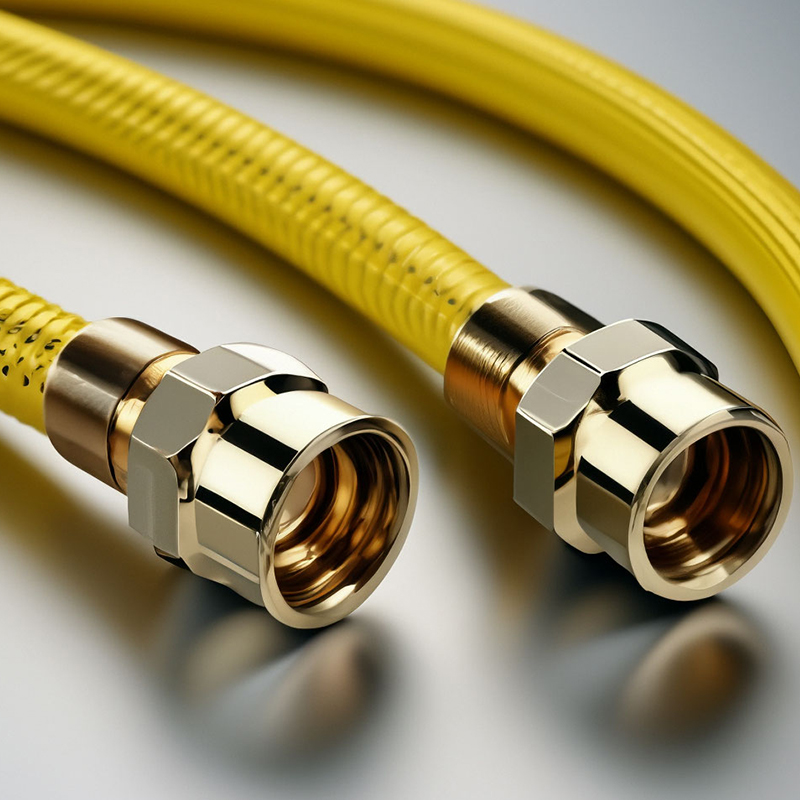
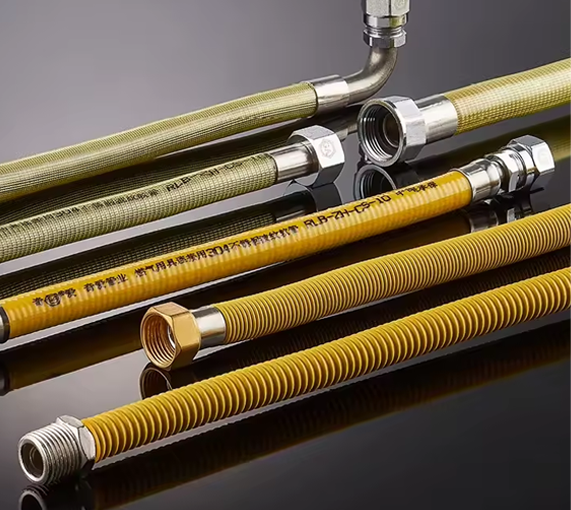
A Yellow Coated Stainless Steel Gas hose is a standard corrugated stainless connector with an added outer jacket, most often finished in yellow so it is quickly recognizable among other flexible lines in a kitchen or utility area. The coating adds a layer of abrasion and grease resistance on top of the stainless core, which is useful in busy kitchen environments where a connector may brush against cabinet edges, cleaning tools, or spilled cooking liquid over the years. Common places this style of connector shows up include the following.
- Residential and light commercial gas ranges positioned in high-traffic kitchen areas
- Gas dryers located in utility rooms where the hose may be visible and benefits from color identification
- Installations where a technician wants to visually separate a gas line from nearby water or drain lines at a glance
- Retrofit projects where matching the coating color of an existing connector is preferred for a consistent look
The added jacket does not change the underlying nominal size logic covered earlier in this article. Sizing a yellow coated connector still comes down to matching the fitting threads on both ends and confirming the rated capacity against the appliance nameplate.
Sizing Mistakes That Reduce Appliance Performance
Most sizing complaints trace back to a small number of repeated mistakes during selection or installation.
- Choosing a connector length based only on the distance from the wall opening rather than the actual valve position.
- Assuming every gas range uses the same nominal size without checking the current appliance nameplate.
- Reusing an older connector on a replacement appliance without verifying the inlet fitting size still matches.
- Overlooking the difference between a connector's nominal size label and its actual internal flow diameter.
- Mixing thread types between the shutoff valve and the connector fitting, which can cause a poor seal at the joint.
Choosing A Stainless Steel Flexible Gas Connector Manufacturer
Once the correct size and coating type have been identified, the next decision is which stainless steel flexible gas connector manufacturer to source from, particularly for buyers placing bulk or repeat orders. A reliable stainless steel gas connector supplier should be able to hold consistent corrugation depth and wall thickness across production runs, since even small variation in these dimensions changes both the bend radius and the rated flow capacity discussed earlier in this article.
For buyers exploring flexible gas connector wholesale arrangements, it is worth confirming that the factory can supply a full nominal size range from 3/8 inch through 1 inch, along with multiple coating options including bare stainless, PVC coated, and yellow coated finishes, so that a single order can cover several appliance categories at once. When comparing a gas connector manufacturer China based buyers are considering, useful questions to ask include how raw coil stock is screened before forming, how corrugation and braiding processes are monitored during production, and whether fitting threads are checked against reference gauges before packing.
An OEM stainless steel gas connector program is often the most efficient path for distributors and appliance brands that need custom coil diameters, custom lengths, or branded packaging, including a dedicated stainless steel flexible gas connector for stove line built around a specific appliance platform. Key evaluation points typically include the following.
- Production scale and ability to maintain consistent wall thickness across large orders
- Range of nominal sizes and coating options offered from a single factory
- Support for custom coil length, fitting configuration, and packaging for OEM programs
- Documented process control from raw material screening through final inspection
About Haoyin (Ningbo) Bellows Technology Co., Ltd.
Haoyin (Ningbo) Bellows Technology Co., Ltd. is a professional enterprise focused on the research, design, manufacturing, and sale of stainless steel bellows, working to provide safe and durable flexible connection solutions for gas, plumbing, heating, and related fields. The company operates as an OEM stainless steel flexible gas connector manufacturer and an ODM custom CSST gas connector factory, supporting buyers who need either standard product lines or fully customized specifications.
The facility covers an area of 35 mu and includes 18,000 square meters of standardized production workshops, supported by management systems including ISO9001, ISO14001, and ISO45001. Recognized as a National High-tech Enterprise and a Green Factory, Haoyin follows a production philosophy built around consistency and quality, with a process that runs from raw material screening and structural design through manufacturing, performance testing, and after-sales support.

Request Product Specifications And Wholesale Information
Buyers who have identified the nominal size, coating type, and length needed for their project are welcome to send appliance specifications for a matching product recommendation. Whether the requirement is a small trial order of a Stainless Steel Flexible Gas Connector for a single product line, a bulk flexible gas connector wholesale order, or an OEM stainless steel gas connector program with custom branding, sharing the appliance type, required nominal sizes, and target coating finish helps speed up the response with accurate specification sheets.
Frequently Asked Questions
-
Q1. What is a stainless steel flexible gas connector
It is a corrugated stainless steel tube fitted with connection ends, used to link a gas appliance to a shutoff valve while allowing some flexibility in routing and appliance placement.
-
Q2. How does a stainless steel flexible gas connector work
The corrugated wall structure lets the tube bend around obstacles while still carrying gas safely between the shutoff valve and the appliance inlet fitting.
-
Q3. What are the advantages of stainless steel gas connectors
They combine flexibility for easier installation with a durable metal core that holds up to repeated bending during cleaning, servicing, or appliance replacement.
-
Q4. How long does a stainless steel flexible gas connector last
Service life depends on installation conditions and how often the connector is flexed, so periodic visual inspection for wear at bend points is a reasonable practice.
-
Q5. Are stainless steel flexible gas connectors safe to use
When the correct nominal size, matching thread fittings, and a routing path free of kinks or sharp bends are used, this style of connector is a widely used method for appliance hookups.
-
Q6. Can flexible gas connectors be used for natural gas
Yes, this connector style is commonly used for natural gas appliance connections in residential and light commercial settings.
-
Q7. Can flexible gas connectors be used for propane gas
Yes, the same corrugated stainless steel construction is also used for propane appliance connections, with fitting selection following the appliance and valve thread size.
-
Q8. Are stainless steel gas connectors resistant to corrosion
Stainless steel is generally selected for this application because of its resistance to corrosion compared with many other metals, which supports a longer service life in kitchen and utility environments.
-
Q9. What material is used to make flexible gas connectors
The core tube is corrugated stainless steel, and depending on the product line it may be left bare or finished with an outer coating such as PVC or a yellow protective jacket.
-
Q10. What is the difference between CSST and a PVC coated connector
CSST gas connector tubing is generally used for longer distribution runs throughout a structure, while a PVC coated gas connector is a shorter length product designed to link one appliance to its shutoff valve.