




 English
  Español
  русский


Heat a 10-metre carbon steel pipe from 20 °C to 120 °C and it grows by roughly 12 mm — enough to bow a bracket, overload a pump nozzle or unseat a threaded joint if both ends are anchored. That gap between rigid pipework and thermal movement is exactly what metallic bellows were designed to close. A metallic bellows is a thin-walled metal tube formed into a series of parallel convolutions; it behaves like a precision spring that flexes axially, laterally and angularly while staying pressure-tight, so the pipe can move without pushing force into equipment, supports or joints.
The principle is simple, the engineering is not. Convolutions must be deep enough to travel, the wall thin enough to flex yet thick enough to contain pressure — most hydroformed stainless steel bellows run between roughly 0.3 and 1.5 mm of wall. This guide explains how metallic bellows work, how they are made, which alloys suit which service, and the selection checks that decide whether a bellows lasts decades or fails in its first heating cycle, drawing on production experience at Haoyin, a stainless steel bellows manufacturer in Ningbo, China, supplying corrugated products for gas, water and heating systems.
Key takeaway: a bellows is a spring first and a pressure vessel second. Specify it by movement, pressure and cycle count — never by pipe size alone.
What Is a Metallic Bellows?
Engineering references describe the metallic bellows as an elastic vessel: apply pressure to the outside and it compresses; place it under vacuum and it extends; push or pull along its axis and it moves like a spring and returns. Each convolution contributes a small, repeatable amount of travel, so total movement grows with the number of convolutions — while pressure capacity moves in the opposite direction. That trade-off is the heart of bellows design.
Five parameters define any bellows: convolution pitch (the spacing between folds), crest and root diameter, wall thickness, free length and the end fittings that connect it to the line. The isometric view below shows how they fit together.
Structure of a formed metallic bellows (isometric view)
Nearly every datasheet — and every supplier discussion — comes back to these five terms.
Three Ways to Make a Metallic Bellows
Three manufacturing routes dominate, and each leaves a signature on performance.
Hydraulically formed
A seamless tube is set inside ring dies and expanded from within by internal pressure, forcing the metal into the convolution profile. The result is smooth, concentric convolutions with consistent wall thickness — the industry default for pipeline expansion joints and for the small-bore corrugated stainless connectors fitted to gas appliances and water heaters.
Mechanically (roll) formed
Here the convolutions are rolled into the tube a step at a time. Tooling costs less and larger diameters or thicker walls become practical, which suits HVAC and utility-scale work, at some cost in profile precision.
Edge-welded
Stamped inner and outer diaphragms are welded alternately at their inner and outer edges. Edge-welded bellows deliver the most movement per unit length and highly predictable spring rates, which is why they appear in vacuum valves, semiconductor equipment and precision instruments; the trade-off is lower pressure capacity and fatigue-critical weld seams.
| Type | How it is formed | Typical strengths | Watch-outs |
|---|---|---|---|
| Hydraulically formed | Tube expanded inside dies under internal pressure | Smooth, balanced convolutions; strong pressure capacity | Less travel per unit length |
| Roll formed | Convolutions rolled in progressively | Economical for large diameters and thick walls | Lower profile precision |
| Edge-welded | Diaphragms welded at crest and root | Highest movement per length; precise spring rate | Lower pressure rating; fatigue-critical welds |
What a Metallic Bellows Does in a Piping System
Four jobs dominate, in this order of frequency:
- Compensation — absorbing thermal expansion and contraction so growth never reaches anchors, pumps or equipment nozzles.
- Vibration control — decoupling pump, compressor and fan vibration before it travels down the line as noise and fatigue.
- Misalignment — forgiving the small lateral and angular offsets left behind by fabrication and installation tolerances.
- Sensing and sealing — working as the responsive element in pressure gauges, thermostats and sealed valve stems.
Compensation is the big one, and it is predictable arithmetic. Steel grows by roughly 0.012 mm per metre for every °C of temperature rise — about 0.017 mm for austenitic stainless steel — so a 10 m run heated by 100 °C lengthens by around 12 mm in carbon steel and 17 mm in stainless. The chart shows how quickly that adds up.
Thermal growth of a 10 m pipe run vs. temperature rise
Calculated from standard linear-expansion coefficients: about 0.012 mm per metre per °C (carbon steel) and 0.017 (austenitic stainless).
A bellows sized for that travel keeps the growth away from connected equipment. Our flexible metal compensator / corrugated expansion joint, part of the metal hose and compensator line, is built for exactly this duty in heating, water and industrial pipework.
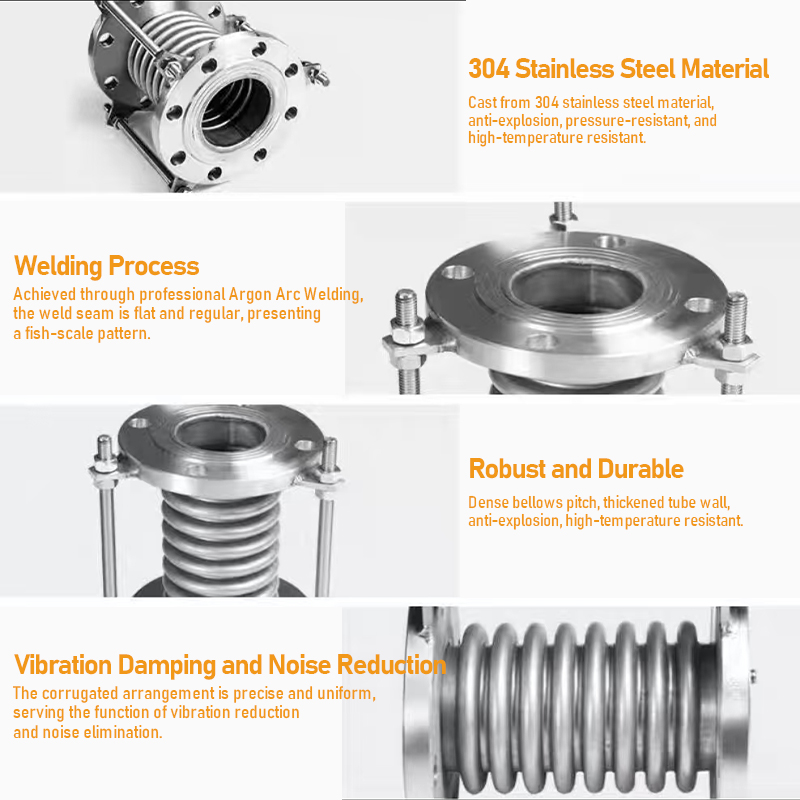 Flexible Metal Compensator Corrugated Expansion JointA stainless steel or carbon steel corrugated expansion joint for absorbing pipe growth in heating, water and industrial systems. Flanged, welded or quick-connect ends, DN255–DN600, handling water, steam and oil at 0.6–1.6MPa.View Product →
Choosing the Alloy: Temperature, Chlorides and Cost
Alloy selection decides how hot the bellows can run, how it copes with the media, and what it costs. The limits below are typical continuous-service figures compiled from expansion-joint manufacturer datasheets; always confirm them against your media, pressure and cycling conditions with the supplier.
| Material | Typical continuous-service limit | Best suited to |
|---|---|---|
| Bronze / brass | About 200 °C | Low-pressure water, gauge and thermostat elements |
| Monel 400 | About 480 °C | Seawater and aggressive chemical media |
| 304 stainless | About 550 °C | General water, gas connectors, heating and steam lines |
| 316L stainless | About 550 °C | Chloride-bearing water, chemical and coastal service |
| 321 stainless | About 600 °C | Stabilised high-temperature duty, heat exchangers |
| Inconel 625 | About 980 °C | High-temperature exhaust and turbine-adjacent lines |
Typical continuous-service temperature limit by alloy
304 stainless matches 316L at about 550 °C; figures are typical datasheet guidance — verify for your service.
Two practical notes. First, 304 stainless is the workhorse for water, gas and heating service, but where chlorides meet elevated temperatures — coastal sites, some process water — 316L resists pitting and chloride stress corrosion far better. Second, fatigue life is designed, not guessed: the EJMA (Expansion Joint Manufacturers Association) method rates a bellows by movement cycles at rated displacement, which is why two same-size bellows can carry very different life ratings.
Where Metallic Bellows Earn Their Keep
Industrial piping, HVAC and energy
Industry overviews of expansion-joint use keep returning to the same shortlist: chemical and petrochemical plants, power generation, HVAC and district heating, water treatment and shipbuilding. Typical mounting points are boiler and heater outlets, pump suction and discharge, and turbine crossovers — anywhere heat, vibration and rigid anchoring meet in one line.
Household gas and water connections
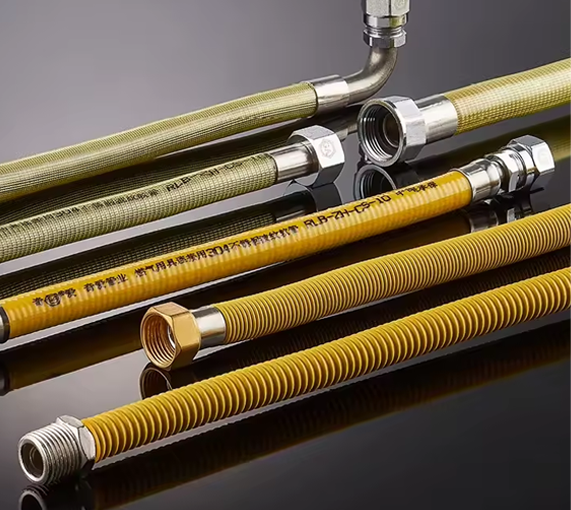
The same technology shrinks down neatly for buildings. A corrugated stainless steel gas connector is effectively a miniature metallic bellows with end nuts, used to hook up ranges, cooktops, water heaters and wall-hung boilers. Residential sizes run from DN10 to DN25, and connectors sold into North America carry CSA certification to the applicable gas-connector standards. Our CSA-certified DN15 connector is the size most commonly fitted to domestic appliances.
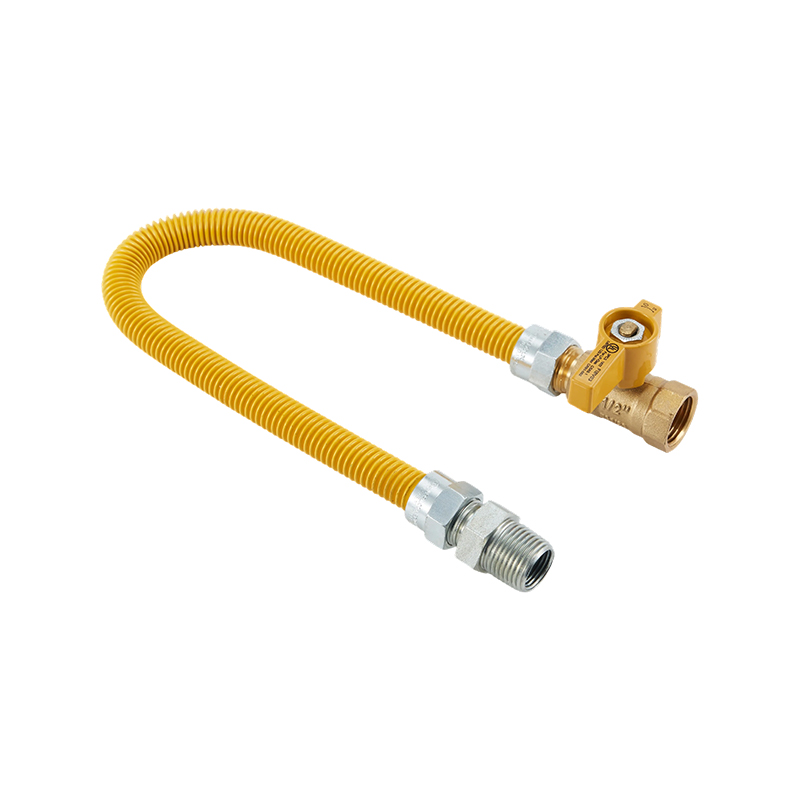 CSA-Certified DN15 Stainless Steel Gas ConnectorA miniature corrugated 304 stainless steel bellows connector with 15/16"-16UNF flare nut, made to link domestic gas appliances. CSA certification and multiple adapter options make it a practical reference point for residential hookup sizes.View Product →
Metal is not the only option, of course. Rubber bellows move further and damp vibration better for the money, but they age, they have real temperature ceilings, and they cannot match metal's pressure containment. The radar chart summarises the trade-offs the industry generally accepts.
Metallic vs. rubber bellows — qualitative comparison (0–5)
Qualitative 0–5 comparison reflecting general industry consensus, not laboratory data.
Selection and Installation: Where Service Life Is Won or Lost
Work through seven checks before ordering:
- Movement — type (axial, lateral, angular), amount and expected cycles per day.
- Pressure — working pressure, test pressure and any vacuum condition.
- Temperature — steady-state level plus start-up peaks, inside and outside the pipe.
- Media — chlorides, oils or gas mixtures that narrow the alloy choice.
- End fittings — weld ends, flanges or threaded nuts, matched to how the joint will be made up.
- Certification — CSA-listed connectors for gas in North America, and ISO 9001-controlled manufacturing for industrial supply.
- Installation — no torsion when tightening, no stretching to close a gap, and correct support so pipe weight never hangs on the fitting.
That last check decides most outcomes: industry failure reviews repeatedly find that early bellows failures trace back to installation and handling — torsion from tightening a nut against the convolutions, over-extension, or pipe weight hanging on the fitting — rather than manufacturing defects. Our article on why metal bellows fail in industrial pipelines breaks the mechanisms down.
For household gas work, match the connector size to the appliance load — DN10 to DN25 covers most residential connectors — and where a long connector runs through a tight cabinet, a whistle-free design suppresses the flow noise that plain convolutions can produce at high draw.
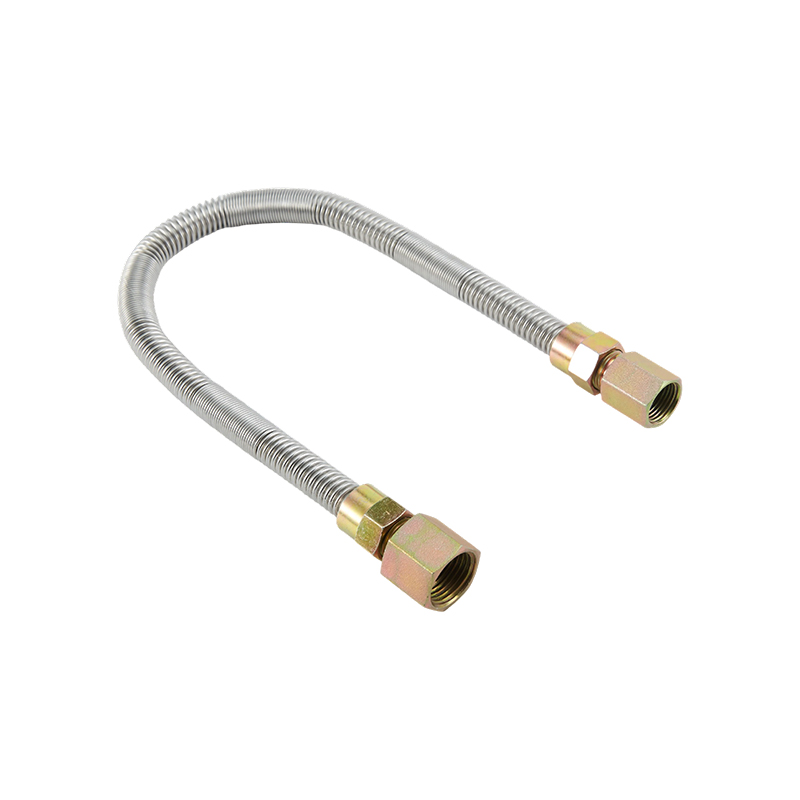 DN20 Whistle-Free Stainless Steel Gas ConnectorThis 304 stainless steel connector pairs a 0.25mm wall with a whistle-free corrugation design that suppresses airflow noise in long runs through tight cabinets. A 1 1/8"-16UNF flare nut and hard seal support leak-free appliance connections.View Product →
Frequently Asked Questions About Metallic Bellows
Q1. What is a metallic bellows used for?
It absorbs thermal expansion, vibration and misalignment in piping systems, and also serves as the sensing element in pressure gauges and thermostats.
Q2. How long does a metallic bellows last?
Life is rated in movement cycles, not just years. Sized by the EJMA cycle method and installed without torsion or over-extension, it typically outlasts the system's maintenance cycle.
Q3. Which is better, a metallic bellows or a rubber bellows?
Metal wins on temperature, pressure and aging resistance; rubber offers larger movements, better damping and lower cost. Match the material to media, temperature and movement.
Q4. What pressure can a metallic bellows handle?
It depends on diameter, wall thickness, ply count and convolution profile. Small-bore stainless connectors serve low-pressure appliance duty, while multi-ply industrial designs reach far higher ratings — always check the pressure class.
Q5. Can a metallic bellows be used on a gas line?
Yes. Corrugated stainless steel gas connectors are standard for ranges, water heaters and boilers; in North America look for CSA certification and the correct DN10–DN25 size.
Q6. How much movement can one bellows absorb?
Each convolution contributes a fixed amount of axial travel at rated pressure, so movement scales with convolution count — but more convolutions reduce pressure capacity, so sizing balances the two.